SAQ 1
A 55 year-old man has just undergone RSI with ETT for acute severe asthma. Immediately post intubation, his SBP falls to 80mmHg.
- List four possible causes for post-intubation hypotension in THIS patient. (4 marks)
- Hyperinflation/gas trapping or stacking
- Hypovolaemia secondary to poor venous return
- Tension pneumothorax
- Myocardial depression/vasodilation secondary to induction drugs
- List four other causes of post-intubation hypotension in any patient. (4 marks)
- Anaphylaxis to induction drugs
- Removal of SNS drive with sedation/paralysis
- PTx
- Pump failure
- Hypovolaemia – volume depletion due to sepsis/dehydration
- Adrenal insufficiency – steroid use/Addisonian crisis
- Outline the steps you will immediately take in this situation. (5 marks)
- Disconnect tube and “feel” with bag – allow excess gas to escape
- Hand ventilate initially, avoiding hyperventilation
- Chest decompression with hands
- Fluid bolus for BP – 500ml NS
- Exclude PTx and treat if present with finger thoracostomy/chest drain
- His BP improves with your measures and you prepare to transfer him to ICU. Complete the following table regarding his ventilator settings.
| Parameter | Ventilator setting |
| Mode | Volume control (VCV) |
| Tidal volume (TV) | 4-6 ml/kg |
| Respiratory rate (RR) | 6-8 /min |
| PEEP | Nil or minimal |
| Peak inspiratory pressure (mmHg) | 35 |
| Plateau pressure (mmHg) | 35 |
| Sats (%) | >92% |
| Inspiration:expiration ratio (I:E) | 1:3 or higher |
| ET CO2 | High – permissive hypercapnia |
SAQ 2
A 46 year old alcoholic presents to your tertiary ED with a large haematemesis. His BP is 85/60, HR 134bpm, afebrile, Sats 99% RA. He is taken to the resuscitation room immediately upon arrival and sectioned due to current intoxication.
- What are the components of the Blatchford Score? (5 marks)
- Urea<6.5, Hb >130, SBP >110, HR <100, no syncope/liver disease.
- What is the utility of the Blatchford score?
- Identifies patients at low risk of serious GI bleed and risk stratifies GI bleeds to identify those patients who are likely to need invasive management/blood transfusion.
- List your management steps in order of priority. (5 marks)
- Airway – airway protection with ETT/RSI – usual doses/tube size
- Breathing – sats > 94% on oxygen
- Circulation – 2 wide bore IV access, fluid resusc to MAP>65
- Urgent VBG for lactate/Hb/K+
- Urgent cross match – consider calling for MTP
- List four medications that are likely to be needed in this patient, including dose and route of administration. (8 marks)Aspirate fluid reveals negatively birefringent crystals with no bacteria seen. Briefly state the diagnosis and two appropriate treatments for this condition. Doses are not required. (3 marks)
- *Octreotide 50-100mcg bolus then infusion of 100mcg per hour (or terlipressin)
- *Pantoprazole 80mg bolus then infusion
- *Vitamin K 10mg
- Thiamine 300mg IV
- FFP/Platelets/PRBC/TXA
SAQ 3
A 67 year-old male presents to your tertiary ED with one hour of chest pain. ECG shows 3mm STE in V3/V4/V5. He is given 300mg aspirin, reteplase 20units, and heparin 5000unit bolus and 1000unit/hr infusion.
Sixty minutes after thrombolysis, he complains of increased left-sided chest pain and dyspnoea. His BP is 85/55, HR 100, RR 26, Sats 92% on 6L Hudson mask. An urgent CXR is ordered.
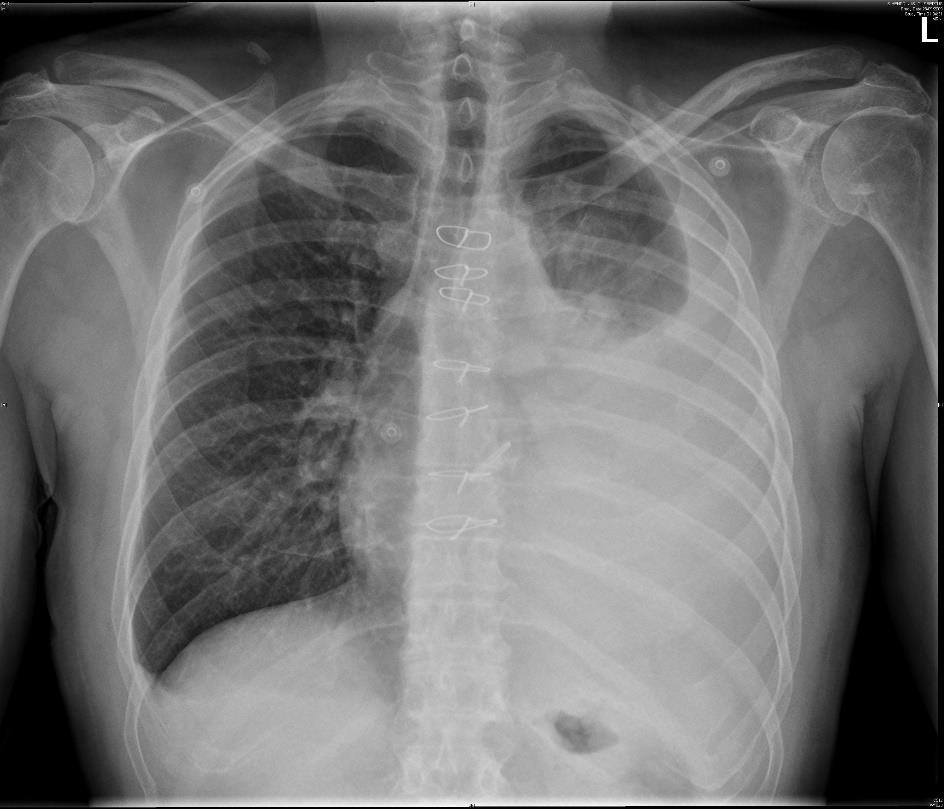
- List three findings on this CXR (positive or negative) and state the main diagnosis of concern. (4 marks)
- Previous CABG – sternotomy wires
- Large left sided pleural effusion
- No ETT/NGT/right lung NAD
- Diagnosis: acute left pleural effusion secondary to thrombolysis
- Outline your immediate management of this patient, including doses where appropriate. (6 marks)
- No points for in resusc/IV access (how did you get the heparin in??)
- Urgent group and save/VBG
- Oxygen to keep sats >92%
- *Cease heparin infusion
- *Reverse heparin with protamine (1mg for each 100 units heparin)
- Left chest drain 32 Fr or larger in 4th/5th ICS MAL
- Consider thoracostomy if >1000ml drained immediately
- Platelets/FFP/cryoprecipitate as indicated
- Consider TXA 1g IV
- List three consults you will seek immediately, with justification.
- CTSU – likely to need thoracostomy/CABG
- ICU – likely disposition
- Haematology – for advice on reversal of thrombolysis/aspirin etc
- Anaesthetics if theatre likely
SAQ 4
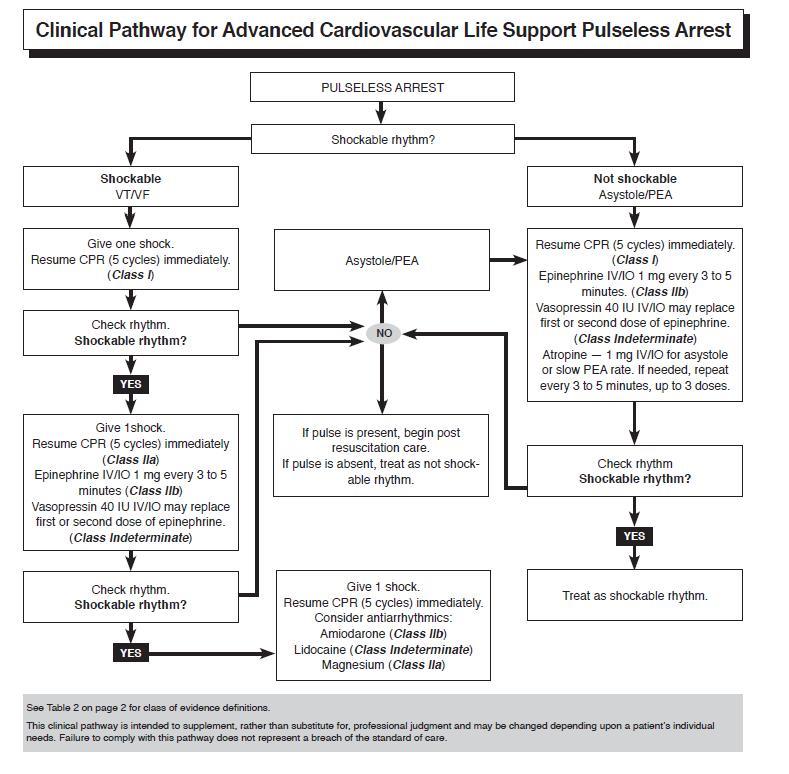
An older version of the ALS algorithm for adults is shown below.
- Please circle five major changes in the algorithm compared with the current 2016 version.
- Any answers of:
*Check rhythm – now we continue CPR for 2 rounds.
*Drugs – atropine, lidocaine, vasopressin, Mg not used anymore
*CPR 5 cycles now listed as 2 mins CPR
*Timing of Epinephrine (adrenaline) now different – shockable every 2/4/6 etc rounds, non-shockable every 1/3/5 etc.
*Also amiodarone in shockable after 3 shocks
- Any answers of:
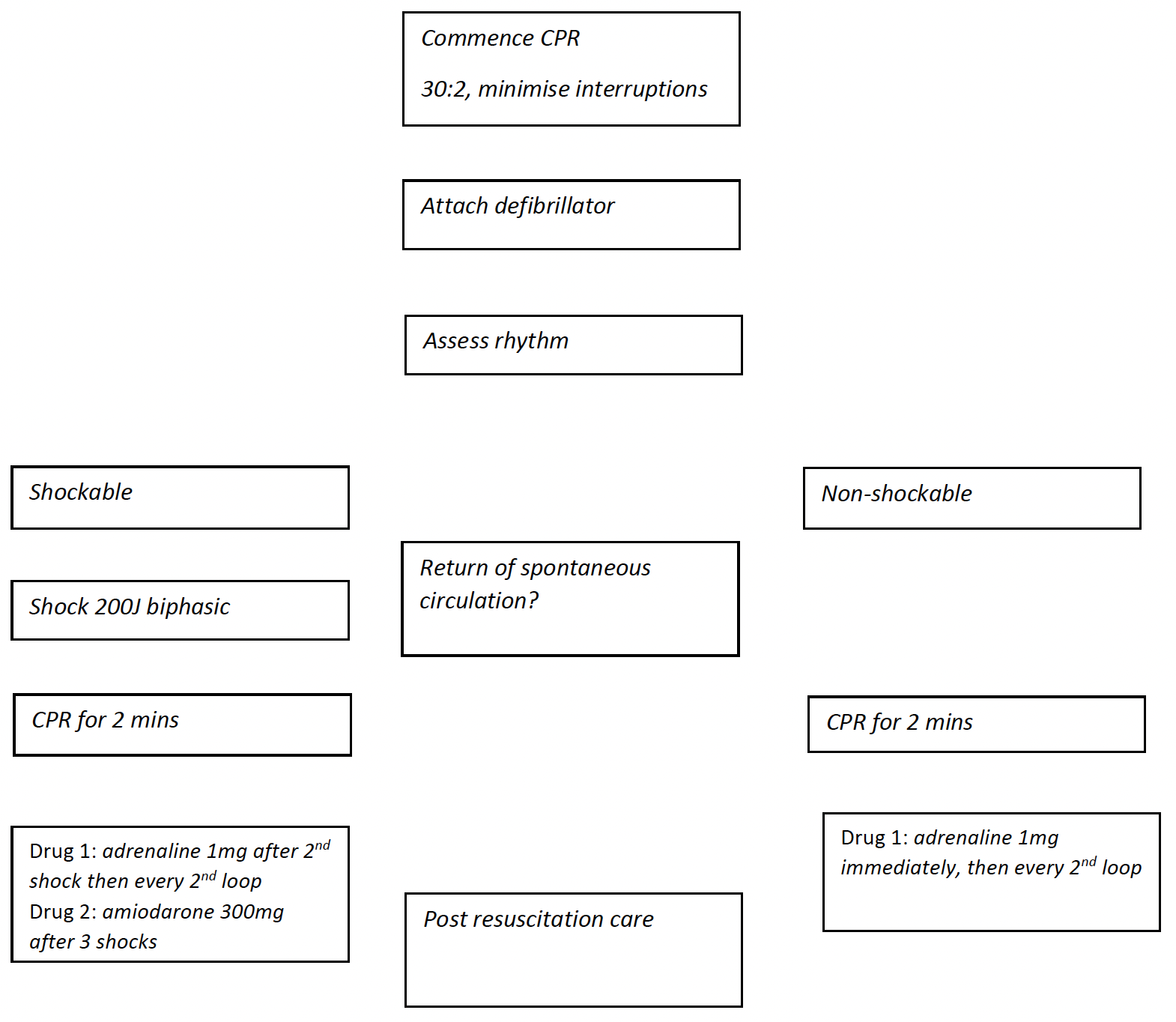
- Draw the current ALS algorithm for Adult cardiac arrest in the spaces below. Assume patient is unresponsive with abnormal breathing and CPR is indicated. (10 marks)
- For each of the following, state a major change between the older version of ALS and the current algorithm. (8 marks)
| Compression:ventilation ratio | Now 30:2 if not intubated, previously different ratios depending on number of personnel |
| Compression or ventilation first? | Compression first before starting ventilation |
| Pulse check before/during CPR | Deemphasised – interrupts CPR, not reliable assessment |
| Charging of defibrillator | Can charge during compressions to minimise time taken to defib |
| Use of stacked shocks | Deemphasised except in witnessed monitored arrests |
| Use of atropine | No longer recommended as routine in non-shockable arrests |
| Use of ETT during CPR | No longer recommended, de-emphasised |
| Monophasic defibrillation | Use of AEDs with biphasic defib recommended |
SAQ 5
A 48 year-old male presents to your rural ED with three hours of chest pain. His BP is 80/60, HR 75, T 37.4C, Sats 98% RA. A VBG is taken and shows a lactate of 4.2. Other parameters are normal. His ECG is shown.
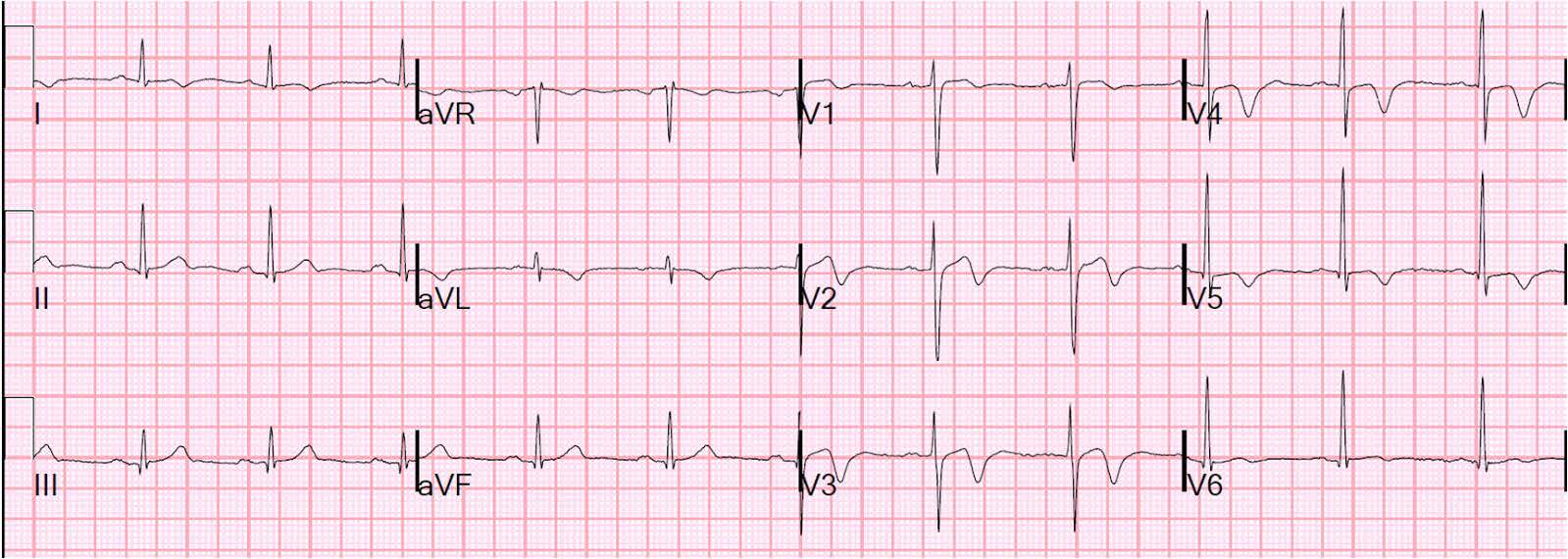
- What abnormality does the ECG show? (1 mark)
- Wellen’s syndrome – biphasic T waves anterior leads, high risk proximal LAD lesion
- Give the likely diagnosis for his presentation and two differential diagnoses. (3 marks)
- Cardiogenic shock due to acute MI (LAD lesion)
- DDx: valvular rupture, cardiomyopathy, arrhythmia etc
- List two options for improving his blood pressure in the short term, giving doses and endpoints where appropriate. (4 marks)
- *no points for PCI – rural setting
- *Isoprenaline 40mcg bolus, 20mcg/minute infusion
- Transcutaneous pacing – aim for electrical and mechanical capture
- The patient receives thrombolysis pending transfer to a tertiary centre for PCI. You decide to insert an intraaortic balloon pump to improve his blood pressure. Briefly describe the mechanism by which an IABP improves BP in cardiogenic shock. (3 marks)
- By inflating during diastoly and deflating during systoly, the balloon increases coronary perfusion during diastoly and decreases myocardial work and SVR/intracardiac shunting/mitral regurg if present.
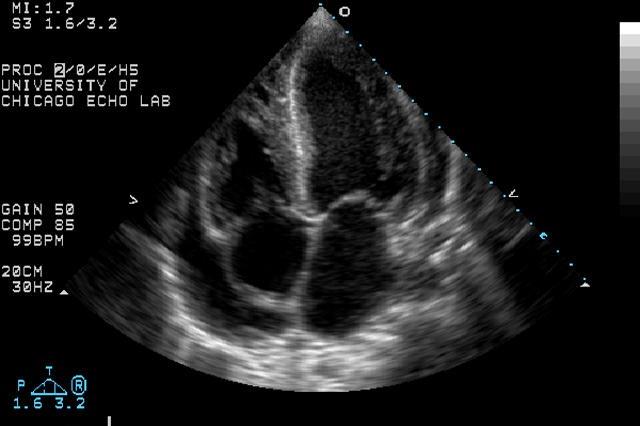
- His BP remains low after insertion of the IABP. A bedside ultrasound is performed and the following image obtained. List two abnormalities on this image and the likely diagnosis. (bonus points: label the picture and state which ultrasound view it is!). (3 marks)
- Collapse of right heart
- Large pericardial effusion adjacent to the right side of heart
- View: subcostal view
SAQ 6
An 8 week old male is brought to ED with four hours of increasing breathing difficulty. He has a 4 day history of increased cough and conjunctivitis for 2 days. On arrival, he is triaged to resuscitation and monitored. He is mottled and lethargic. His HR is 180/min, RR 65/min, T 37.9°C, and his saturations unrecordable due to a poor trace. His BGL is 3.4mmol/L.
- List your initial resuscitation steps in order of priority for this neonate.
- Keep warm – neonate warmer or similar
- Oxygen to keep sats >92%
- Urgent IV/IO access
- The child is diagnosed with sepsis and deteriorates. Complete the following table regarding this child. Doses may be given in mg/kg or similar if preferred.
| Parameter | Estimate |
| Weight of child | 5kg |
| Fluid bolus | 100ml |
| Dextrose bolus | 100ml of 10% |
| ETT size | 3 or 3.5 |
| ETT depth | 15cm |
| Antibiotic (empirical) | Cefotaxime 400mg |

