SAQ 1
A 60-year-old male presents with one hour of anterior epistaxis. He has a history of HTN and AF, for which he is on warfarin. His observations are: BP 110/60, HR 60, Afebrile, Sats 98% RA.
- List five immediate steps in your management of this patient.
- Move patient to resuscitation room
- Full PPE
- Nasal pressure for 15 minutes
- Sit patient upright
- IV access and take bloods
- Simple pressure fails to control his bleeding and you have already suctioned all visible clots. List three more invasive options to control his bleeding directly.
- Cautery – silver nitrate
- Nasal packing (rapid Rhino, tampon)
- Cophenylcaine pledgets
- His bleeding persists despite these efforts and ENT input is requested. They are travelling from another hospital, and request reversal of his warfarin in the interim. What drugs and doses will you administer to achieve reversal?
- Vitamin K 5-10mg IV
- Prothrombinex 25-50 units/kg IV
- FFP 1-2 units
- How does complete reversal of his warfarin affect his annual risk of stroke, assuming he has no other medical issues and his AF is chronic?
- Risk of stroke in AF without warfarin – 5%
- Risk of stroke in AF on warfarin – 1.5%
SAQ 2
A 4-year-old boy presents with a peanut up his left nostril.
- Give four methods for removing the peanut in ED.
- Suction
- Fine forceps under direct vision
- Kiss method
- Glue on stick
- After removing the peanut, you notice the child is hypotensive, floppy, and has a widespread urticarial rash. You diagnose anaphylaxis and decide to intubate the child. Complete the following table with appropriate values.
| Factor | Value |
| Estimated weight of child | 16kg |
| Size(s) of ETT | 5, 4.5 |
| Induction – sedation | Ketamine 16mg |
| Induction – paralysis | Suxamethonium 16mg |
| Fluid bolus | 160ml NS |
| Adrenaline dose (IM) | 160mcg (0.16ml of 1:1000) |
SAQ 3
A 45-year-old male is brought into ED by ambulance after attempting to hand himself with a belt in his bedroom. On arrival, he is GCS 7.
- Briefly describe the different mechanism of death in judicial vs non-judicial hanging.
Judicial: drop is at least height of victim; fall causes hyperextension – C spine # – cord transection – death by respiratory failure
Non-judicial: venous obstruction – cerebral hypoxia – loss of consciousness – muscles relax – airway occlusion and arterial occlusion. - Give five anticipated complications of hanging in this patient.
- Laryngeal oedema
- Laryngeal fracture
- ARDS
- Cerebral oedema
- Pulmonary oedema
- Seizures
- SC injury
- Thrombus/embolus
- Hypoxia, vascular injury, aspiration pneumonia
- List five symptoms/signs that predict a poor outcome in hanging victims.
GCS on arrival is NOT prognostic! The following features are prognostic:- C spine #
- Long hanging time
- Anoxic brain injury on CT
- Cardiopulmonary arrest
- Hypotension on arrival
- Low PaO2/FiO2 on arrival (<100)
SAQ 4
A 58 year old female presents to your rural ED with 5 days of sore throat and progressive dysphagia. Examination shows she is febrile, with stridor at rest. Oropharyngeal examination is unremarkable.
- Give 4 differential diagnoses for her symptoms
- Retropharyngeal abscess
- Epiglottitis
- Anaphylaxis/angioedema
- Foreign body with abscess
- Bacterial pharyngitis
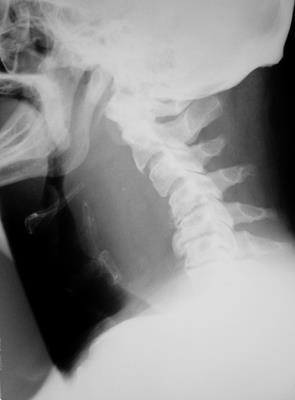
- A lateral neck X ray is obtained. List 3 findings (positive or negative) on this x-ray and suggest the most likely diagnosis.
- + Widened prevertebral soft tissue shadow at C2-C4.
- + Loss of normal airway contour/narrowed airway.
- – Thumb sign (enlarged epiglottis) not present.
- Most likely dx: retropharyngeal abscess.
- Give four management options for this patient with doses where appropriate.
- Antibiotics – metronidazole 500mg IV and ceftriaxone 2g IV
- Dexamethasone 8mg IV
- Nebulised adrenaline 5ml of 1:1000
- Urgent ENT input – likely early airway issue
SAQ 5
A 25-year-old male presents with facial pain following an alleged assault on Saturday night (see image).
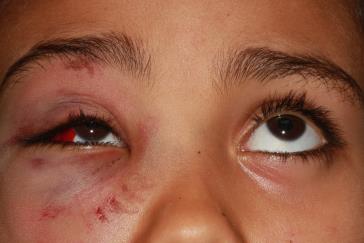
- List four features on this image that suggest a fracture involving the zygomatic bone or zygomatico-maxillary complex.
- Periorbital bruising, oedema
- Restriction of upgaze
- Cheekbone depression
- Subconjunctival haemorrhage
- List four other clinical findings that would suggest this injury.
- Surgical emphysema around eye
- Vertical diplopia
- Enophthalmus/exophthalmos
- Infraorbital anaesthesia (numb lower lid, cheek, side of nose, upper lip/gum)
- Palpable step at infraorbital margin or lateral brow area
- Decreased visual acuity – suggests retrobulbar haemorrhage (urgent Ophthlm)
- What features on examination mandate urgent operative management of this fracture?
- Significant cosmetic/functional deformity
- Visual compromise
- Exophthalmos/enophthalmos
- EOM entrapment
- Globe displacement
- Significant orbital floor disruption
- After surgical review, the patient is discharged with operative management in 5 days time. What advice will you give the patient on discharge?
- Do not blow nose – risk of emphysema
- Prophylactic antibiotics – high risk of communication with sinuses
- Return if increased symptoms
- The following day, the patient returns with increased pain and decreased acuity (image).
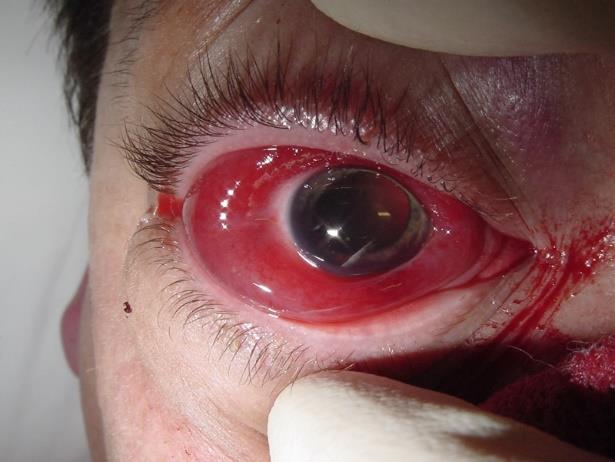
- What is the diagnosis?
- Traumatic retrobulbar haemorrhage
- Briefly describe the steps involved in lateral canthotomy.
- Inject 1% lignocaine with adrenaline around the lateral aspect of the eye
- Advance a haemostat from the lateral canthus to the outer orbital rim and clamp to devascularise the tissue
- Use small scissors to cut from the lateral canthus to the outer orbital rim
- Cut the lower canthal tendon to decompress the globe
- If IOP remains raised, cut the upper canthal tendon as well

