SAQ 1
A 72-year-old male presents with central chest pain for 2 hours. The pain is sharp, radiates to his back, and appears to be diminishing. His observations are BP 210/100, HR 80, Sats 98% RA. There is no pulse or BP discrepancy between his arms. You suspect aortic dissection.
- List four risk factors for aortic dissection.
- The patient is moved to resus and a CXR obtained (below). List four features on this CXR suggestive of dissection.
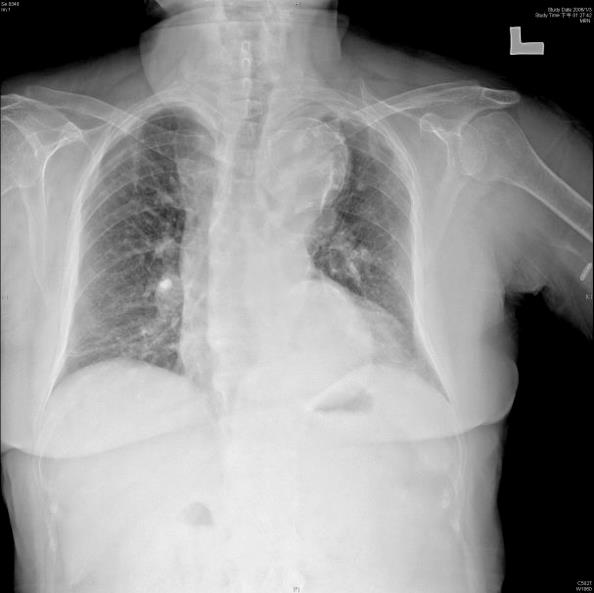
- A CTA confirms a DeBakey type 3 dissection. List your management priorities for this dissection, giving endpoints where appropriate.
- List four contraindications to surgical repair of aortic dissection.
SAQ 2
A 68-year-old Aboriginal female presents to your rural hospital with acute pain and paraesthesia in her right leg. Her medications include warfarin, digoxin, and metformin. She is a chronic smoker and has thrice weekly dialysis for end-stage renal failure.
- List three differential diagnoses for her presentation.
- You suspect acute ischaemic limb. List four investigations you will order with justification.
- CT angiography confirms acute 100% occlusion of the right femoral artery. What is the role of thrombolysis in this patient?
SAQ 3
A 48-year-old male is yelling at triage, demanding urgent pain relief or he will leave. He is a “frequent flyer” to ED, with regular presentations related to alcohol abuse. He was seen two days prior after a fall and a below knee cast was applied for a fractured right tibia/fibula. He appears intoxicated.
- List three issues that need urgent management in this patient.
- After calming the patient, you examine his right leg. The toes below the cast are white and swollen. List two clinical signs/symptoms strongly suggestive of an acute compartment syndrome.
- Regarding the development of ischaemic limb:
- What is the traditional time frame after which ischaemia is likely to be irreversible?
- What is the traditional time frame after which ischaemia is likely to be irreversible?
- Outline in order, the four steps you would take to manage his compartment syndrome in ED.
SAQ 4
A 75-year-old male is brought to ED with 24 hours of melena. He has a past history of AAA with endoluminal stenting 10 months ago. His observations are BP 135/85, HR 80, GCS 15/15. On examination, he has a palpable non-tender aorta and melena on PR.
- Give three differential diagnoses for his presenting complaint.
- You diagnose a likely aortoenteric fistula (AEF). What is the difference between a primary AEF and a secondary AEF?
- List three methods of diagnosing an AEF in this patient with a pro and con for each method.
SAQ 5
A 23 year old painter recently diagnosed with Bordatella pertussis presents with gradual onset headache. The pain has been present for four days and is right sided. He states the pain came on after a particularly vigorous coughing episode.
- Give three differential diagnoses for his presentation.
- On examination, you find the following (image). What is the likely diagnosis?
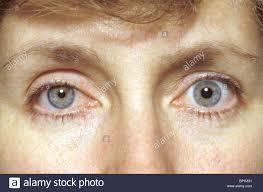
- List three management options for this condition, assuming the condition does not extend intracranially.
SAQ 6
You are working as a senior registrar when an earthquake strikes the hospital you are working in, causing widespread damage to the building. Two hours into retrieval, you commence rescue of a young RMO who has been trapped by the left leg under masonry since the quake occurred.
- List two precautions you will take prior to attempting removal of the RMO from the masonry.
- Despite your best efforts, the RMO arrests soon after the leg is freed. An ECG is obtained during CPR (below). Briefly explain the pathophysiology behind this ECG.
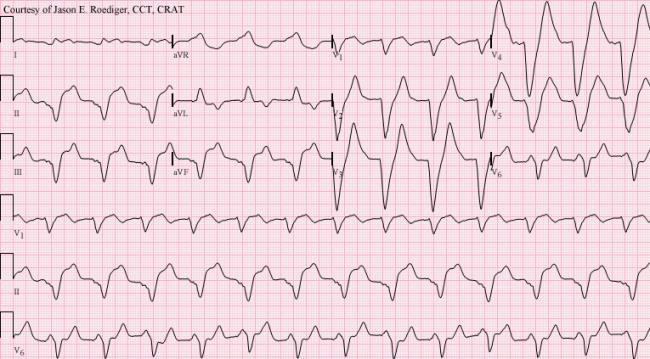
- Outline how you will manage this electrolyte derangement acutely.
- What is the role of permissive hypotension in this trauma patient?

