SAQ 1
- List five diagnostic criteria for Kawasaki Disease (KD) in a 4 year old boy with fever.
- All diagnostic criteria for KD are met in this patient. List and justify 3 investigations in this child.
- List three possible treatment options for KD in this patient.
SAQ 2
A 3-month-old girl is brought into ED with pallor and lethargy for the past hour. She has had fevers and URTI symptoms for the past 3 days. Her observations are as follows:
GCS 15/15 but floppy/lethargic
HR 220
BP 75/45
CRT 2 seconds
Sats 95% RA
Temp 38.2 C
This is her ECG.
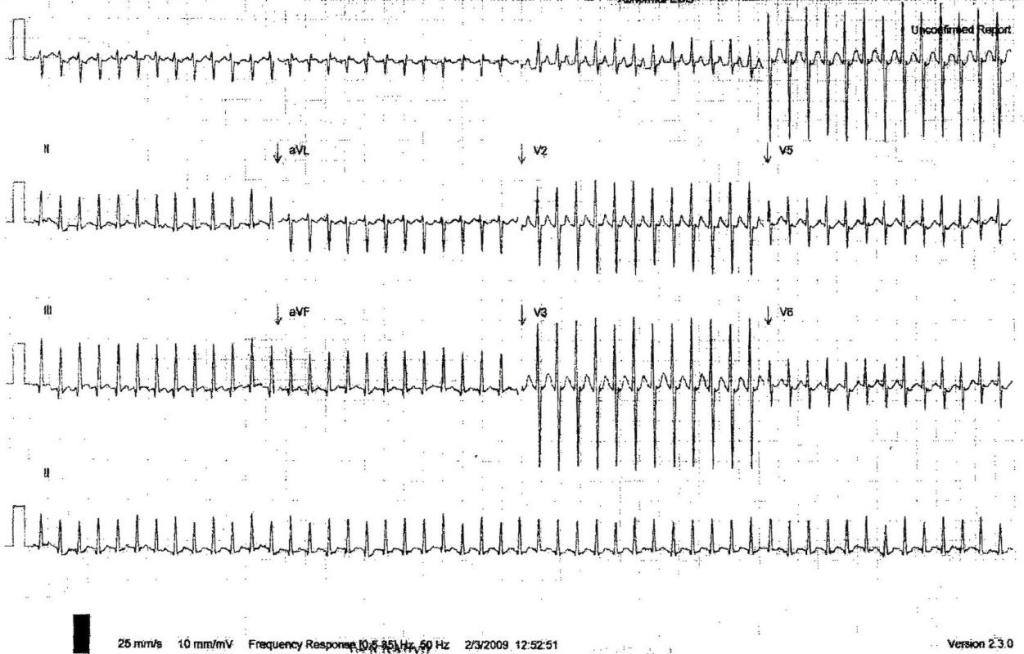
- What is the most likely diagnosis?
- What are two features of the ECG that support this diagnosis?
- List 3 treatment options in the order of escalation that you would perform them.
- List 4 investigations you would perform in the ED with a justification.
SAQ 3
A 4 year old girl presents with anaphylaxis after a bee sting. She is poorly responsive, pale and floppy. She has no stridor but widespread wheeze on chest auscultation.
Her observations are: HR 152, BP 68/42, RR 56, T 37, Sats 92% on 10L oxygen.
- List five immediate steps in your management of this child, including doses where necessary.
- The child remains poorly responsive after these measures and you decide to intubate. What two sizes of ETT will you prepare for intubation?
- Her BP remains low post-intubation and two fluid boluses and her peripheries are cold. What inotrope will you use and why? Give dose.
SAQ 4
A 4 week old child is brought to ED by his concerned parents with four hours of increasing breathing difficulty. He has a four day history of increased cough and conjunctivitis. On arrival, he is triaged to resus, IV access obtained and monitored. He is mottled and lethargic. His obs are: HR 180bpm, RR 65, T 37.9 (axilla), and sats unmeasurable due to poor trace. BGL is 5.4mmol/L.
- List 8 differential diagnoses you would consider in this child’s presentation.
- List three initial steps in your resuscitation of this child with justification.
SAQ 5
A 3 year old boy is brought in by his mother refusing to weight bear on his right leg. His mother says he started limping 3 days ago and now will not walk. The child appears otherwise well and has no past medical history.
- Fill out the following table regarding differential diagnosis of the limping child.
| Diagnosis | Cause | Findings on clinical exam/posture | Typical age onset | Risk factors |
| Septic join | ||||
| Transient synovitis | ||||
| Perthes | ||||
| SCFE* |
SCFE – slipped capital femoral epiphysis
- Give three tests you would order in this child and justify.
SAQ 6
A 6 year old presents after running into a coffee table, sustaining a laceration above her right eyebrow. There was no loss of consciousness and no other injury. The wound needs sutures. Complete the following table of anaesthetic options in this child (one example per box).
| Medication | Dose/route | Advantage | Disadvantage |
| Midazolam | |||
| Ketamine | |||
| Propofol | |||
| Nitrous oxide | |||
| Fentanyl |
SAQ 7
A 6 year old child with no significant PMHx presents with abdominal pain and vomiting. Her observations are BP 74/45, HR 158 bpm, RR 50, T 37, Sats 100% RA.
- Give three differential diagnoses for this presentation.
- Her BGL is “high” and ketones are present in her urine. List your management of her DKA, giving doses and endpoints where appropriate.
SAQ 8
A 5 year old boy is brought to your major referral ED by his mother, who states he was bitten on his ankle by a snake an hour ago. He has a pressure immobilisation bandage in place. He is currently asymptomatic with stable vitals.
- Give four features on assessment that would indicate envenomation?
- An hour later, the child remains asymptomatic. Initial investigations are normal. The PIB is removed. List the 3 criteria which need to be met for the child to be discharged.
- How many hours are considered adequate observation to ensure envenomation has not occurred in Australia?
SAQ 9
- List 6 medications/substances that are potentially lethal in children with only a small amount ingested?
- A 2-year-old child presents after a suspected accidental drug ingestion. The child has been seizing for 10 minutes.
- A 2-year-old child presents after a suspected accidental drug ingestion. The child has been seizing for 10 minutes.
- Give two medications that may be given with neither IV or IO access, with route of administration and dose.

