SAQ 1
A 64 year old male presents to your rural ED with 30 minutes of right arm pain. He is a smoker, has HTN and DM, but denies high cholesterol. His ECG is shown.
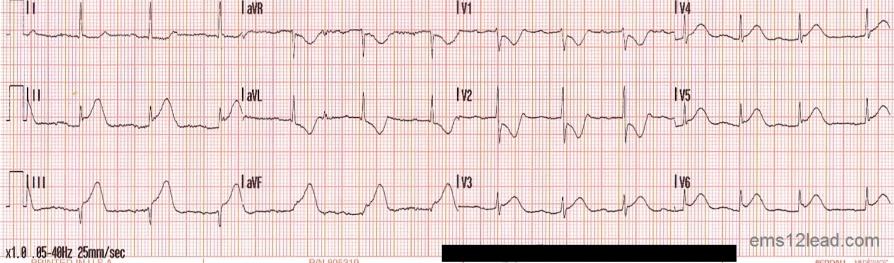
- List two abnormalities on the ECG and give your diagnosis. (3 marks)
- ST elevation in inferior (II, III, avF) and lateral (V5/V6) leads – inferolateral STEMI
- In which coronary artery is the culprit lesion? (1 mark)
- Left circumflex
- You decide to thrombolyse. State the drug, dose, route, and rate of administration. (3 marks)
- tPA 0.9mg/kg, max 90mg. Give 10% over 10 mins, then rest over one hour.
- List 6 absolute contraindications to thrombolysis. (6 marks)
- Previous haemorrhagic stroke, ischemic stroke <3/12, active bleeding (not menses), aortic dissection, known intracranial vascular lesion, intracranial malignancy, head/facial trauma 3/12.
- Ninety minutes after thrombolysis, the patient is still in 8/10 pain with persistent ST elevation on his ECG. What is your next step? Justify your choice. (2 marks)
- Transfer to nearest PCI centre for angio. Failed thrombolysis, so needs rescue PCI. Repeat thrombolysis won’t do anything.
SAQ 2 (follows on from SAQ 1
Whilst preparing the patient for transfer, the nurse repeats the ECG (shown).
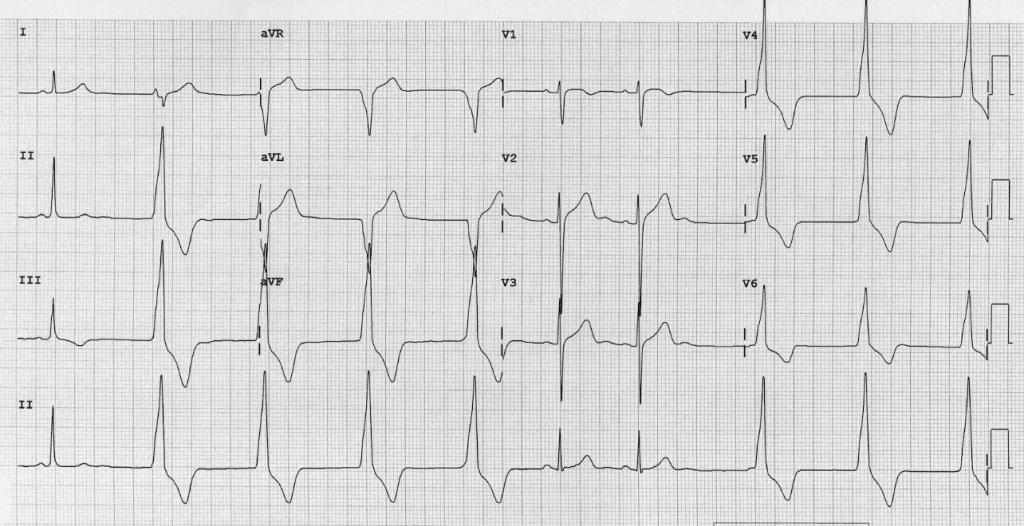
- What is the rhythm shown? (1 mark)
- Accelerated idioventricular rhythm – regular, rate 50-110, 3 or more ventricular complexes, wide QRS complexes, fusion and capture beats.
- The patient remains haemodynamically stable. What actions do you take given the ECG changes? Justify your answer. (2 marks)
- None – this rhythm is common after thrombolysis and has no prognostic value.
- Two years after being treated for his MI, the patient presents with three angina attacks at rest over the pat 24 hours. He is now on aspirin, metoprolol, and a statin. His ECG and troponin are normal. What is his TIMI score? (2 marks)
- TIMI score is 5 (age >65, known IHD, use of aspirin, 2 or more attacks angina, >3 risk factors for IHD)
- States his disposition and justify your reasoning. (2 marks)
- Likely unstable angina. Needs cardiology admission for this, even if troponins negative. May need urgent PCI.
SAQ 3
A 46 year old female presents to ED with chest pain for 24 hours. She is a smoker and has hypothyroidism. The pain is described as sharp chest pain, radiating to the left arm and neck, and is associated with dyspnoea. Her sats are 94% on RA. Her ECG is shown.
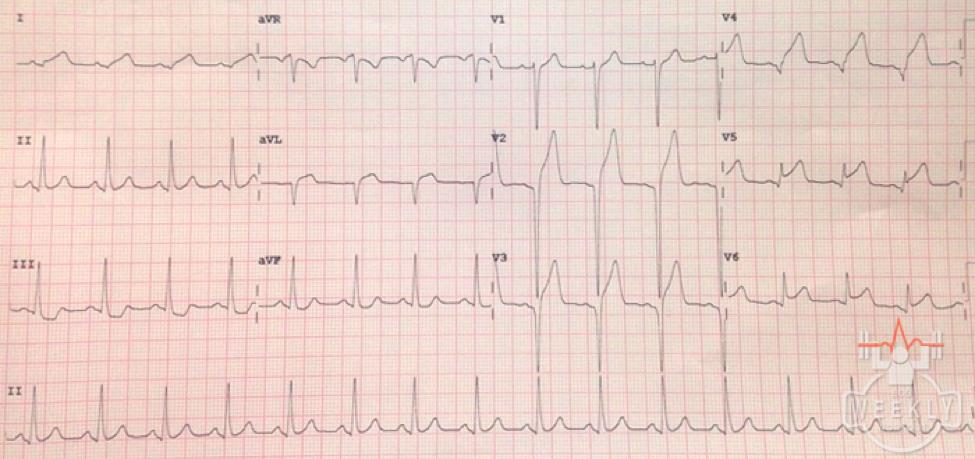
- State the likely diagnosis, giving two features of the ECG that support your diagnosis. (3 marks)
- Widespread concave ST elevation, PR depression evident. Likely pericarditis.
- List four likely causes of this diagnosis in THIS patient. (4 marks)
- Hypothyroid – immune related pericarditis, infectious, systemic rheumatic disease, myxoedema, idiopathic.
- How can the ST/T ratio be used to differentiate between pericarditis and benign early repolarisation?
- ST/T ratio high in pericarditis (>0.25-0.5), low in BER.
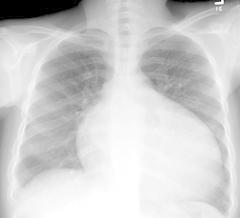
- The patient remains in pain despite analgesia. Her troponin is 46. A CXR is ordered (shown below). What is the likely diagnosis, and how does this change disposition? (2 marks)
- Cardiomegaly and cephalisation of pulmonary vessels, heart failure. Patient has myopericarditis with dilated cardiomyopathy and needs admission for management.
SAQ 4
- Based on current guidelines, what is the recommended timeframe for each of the following interventions? (3 marks)
| i. | Time to first ECG in suspected STEM | 10 mins maximum |
| ii. | Time from patient arrival to PCI | 90 minutes max (poss up to 120mins – Euro guidelines) |
| iii. | Time to thrombolysis | <6-12 hrs if PCI not available in <90 mins |
- For each of the following patients, indicate whether PCI, thrombolysis, or both are appropriate if said patient presents with an acute STEMI. Use a tick to indicate appropriate, a cross to indicate not appropriate.
(9 marks)
| PCI | Thrombolysis | |
| Postpartum 2/52 after LSCS | ✓ | ✗ |
| BP 160/90 | ✓ | ✓ |
| On warfarin, INR 2.5 | ✓ | ✗ |
| 36/40 pregnant | ✓ | ✗ |
| Under CPR for <10 mins | ✓ | ✓ |
| Previous thrombolysis with streptokinase | ✓ | ✓ not streptokinase, though |
| Dressler’s syndrome | ✓ | ✗ |
| THR 2/52 ago | ✓ | ✗ |
| 86 year old with GORD | ✗ | ✗ ? |
- For a patient with acute STEMI and no heart failure or contraindications, list five medications that are given acutely with a brief description of their mechanism of action. (5 marks)
- Aspirin – antiplatelet action
- Clopidogrel/ticagrelor – antiplatelet action
- GTN – vasodilation, reduce myocardial work etc
- Beta blockers – reduce heart rate etc
- Antithrombin – heparin etc – thrombin exposed by fibrinolysis etc
SAQ 5
A 56 year old male presents with right arm pain for two hours. He complains of nausea and dizziness. His BP is 100/60 and his pulse rate 40bpm. His ECG is shown.
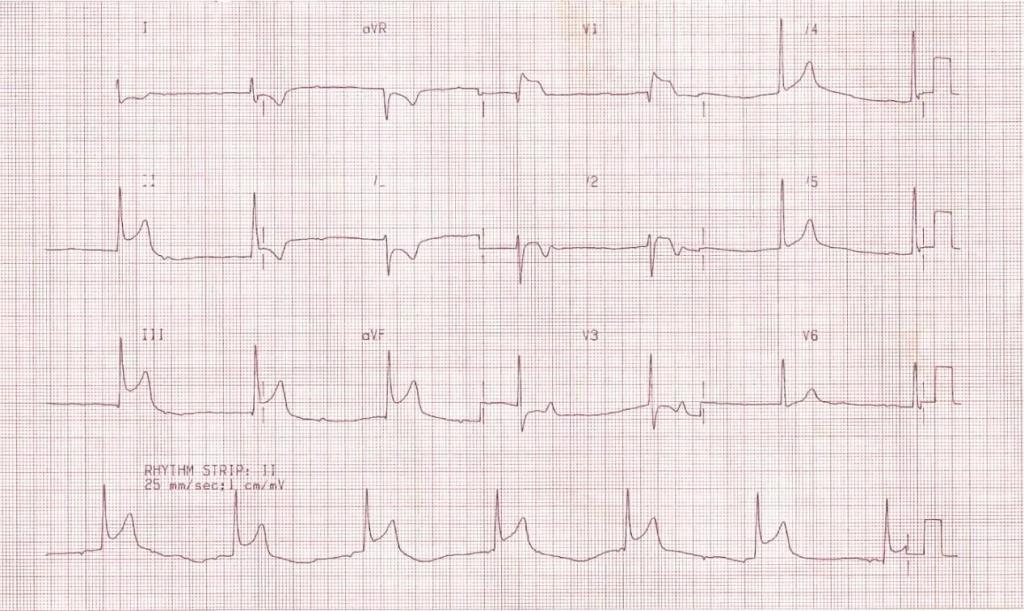
- State two abnormalities on his ECG and give the likely diagnosis. (2 marks)
- Inferior STEMI – STE in inferior leads, STE V1, STD V2. Reciprocal changes.
- State two possible causes of his bradycardia. (2 marks)
- Ischaemia of SA node secondary to MI
- Bezold-Jarisch reflex – vagal response to MI.
- List a pharmacological and a non-pharmacological treatment for his bradycardia. Give doses where appropriate. (2 marks)
- Atropine 0.5mg IV. Pacing – either transcutaneous or transvenous
- The medication for bradycardia fails to have a meaningful result. Briefly outline how you would perform pacing in this patient. (6 marks)
- *Analgesia/mild sedation – painful process
- Pads on – preferably AP, but sternal/lateral would be acceptable
- Start at 10mA – increase by 10 until electrical capture – indicated by pacing spike followed by QRS
- Look for perfusion as marker of mechanical capture – start at 80bpm and increase until adequate perfusion of patient.

