SAQ 1
A 64 year old male presents to your rural ED with 30 minutes of right arm pain. He is a smoker, has HTN and DM, but denies high cholesterol. His ECG is shown.
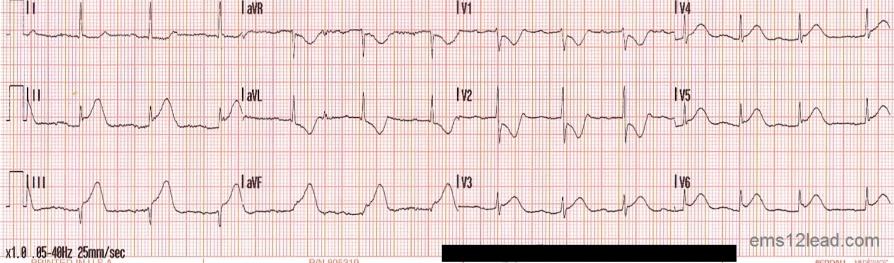
- List two abnormalities on the ECG and give your diagnosis. (3 marks)
- In which coronary artery is the culprit lesion? (1 mark)
- You decide to thrombolyse. State the drug, dose, route, and rate of administration. (3 marks)
- List 6 absolute contraindications to thrombolysis. (6 marks)
- Ninety minutes after thrombolysis, the patient is still in 8/10 pain with persistent ST elevation on his ECG. What is your next step? Justify your choice. (2 marks)
SAQ 2 (follows on from SAQ 1
Whilst preparing the patient for transfer, the nurse repeats the ECG (shown).
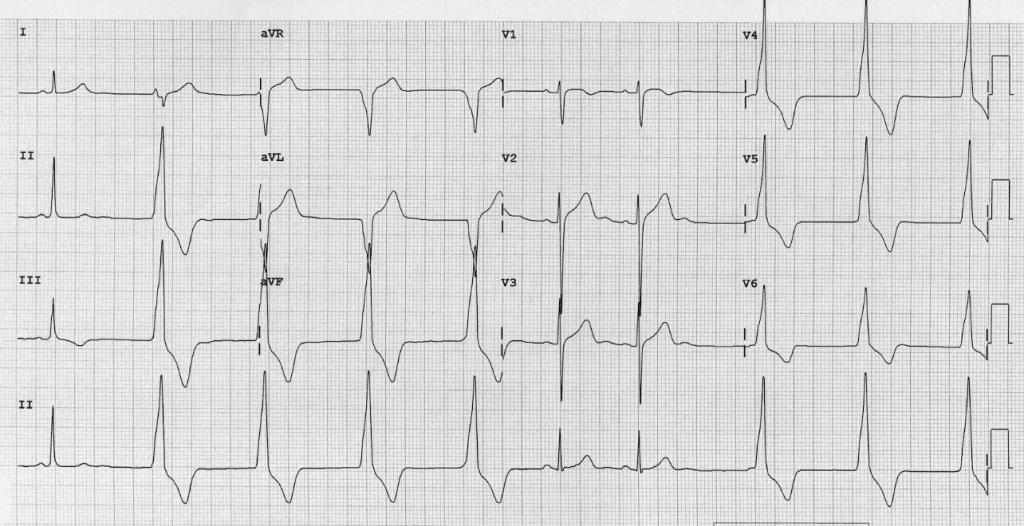
- What is the rhythm shown? (1 mark)
- The patient remains haemodynamically stable. What actions do you take given the ECG changes? Justify your answer. (2 marks)
- Two years after being treated for his MI, the patient presents with three angina attacks at rest over the pat 24 hours. He is now on aspirin, metoprolol, and a statin. His ECG and troponin are normal. What is his TIMI score? (2 marks)
- States his disposition and justify your reasoning. (2 marks)
SAQ 3
A 46 year old female presents to ED with chest pain for 24 hours. She is a smoker and has hypothyroidism. The pain is described as sharp chest pain, radiating to the left arm and neck, and is associated with dyspnoea. Her sats are 94% on RA. Her ECG is shown.
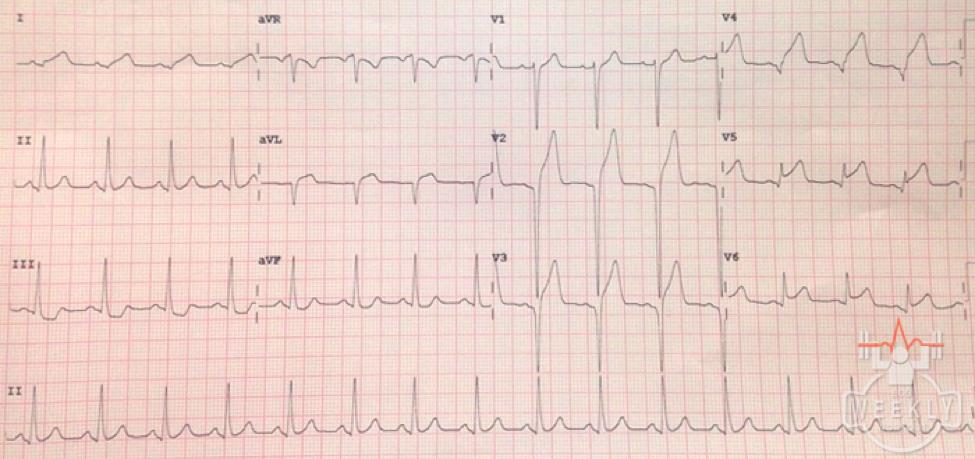
- State the likely diagnosis, giving two features of the ECG that support your diagnosis. (3 marks)
- List four likely causes of this diagnosis in THIS patient. (4 marks)
- How can the ST/T ratio be used to differentiate between pericarditis and benign early repolarisation?
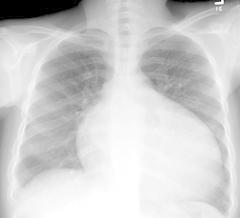
- The patient remains in pain despite analgesia. Her troponin is 46. A CXR is ordered (shown below). What is the likely diagnosis, and how does this change disposition? (2 marks)
SAQ 4
- Based on current guidelines, what is the recommended timeframe for each of the following interventions? (3 marks)
| i. | Time to first ECG in suspected STEM | |
| ii. | Time from patient arrival to PCI | |
| iii. | Time to thrombolysis |
- For each of the following patients, indicate whether PCI, thrombolysis, or both are appropriate if said patient presents with an acute STEMI. Use a tick to indicate appropriate, a cross to indicate not appropriate.
(9 marks)
| PCI | Thrombolysis | |
| Postpartum 2/52 after LSCS | ||
| BP 160/90 | ||
| On warfarin, INR 2.5 | ||
| 36/40 pregnant | ||
| Under CPR for <10 mins | ||
| Previous thrombolysis with streptokinase | ||
| Dressler’s syndrome | ||
| THR 2/52 ago | ||
| 86 year old with GORD |
- For a patient with acute STEMI and no heart failure or contraindications, list five medications that are given acutely with a brief description of their mechanism of action. (5 marks)
SAQ 5
A 56 year old male presents with right arm pain for two hours. He complains of nausea and dizziness. His BP is 100/60 and his pulse rate 40bpm. His ECG is shown.
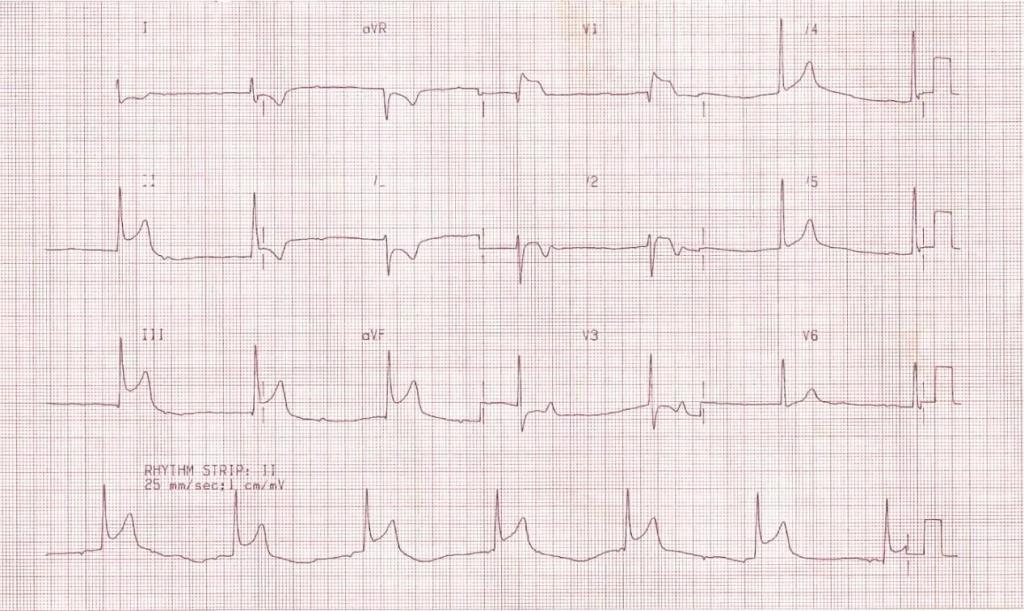
- State two abnormalities on his ECG and give the likely diagnosis. (2 marks)
- State two possible causes of his bradycardia. (2 marks)
- List a pharmacological and a non-pharmacological treatment for his bradycardia. Give doses where appropriate. (2 marks)
- The medication for bradycardia fails to have a meaningful result. Briefly outline how you would perform pacing in this patient. (6 marks)

