SAQ 1
A 32-year-old male presents to triage holding his neck. He tells the triage nurse that he has been stabbed, raising his hand to show the following injury (image). He then collapses to the floor.
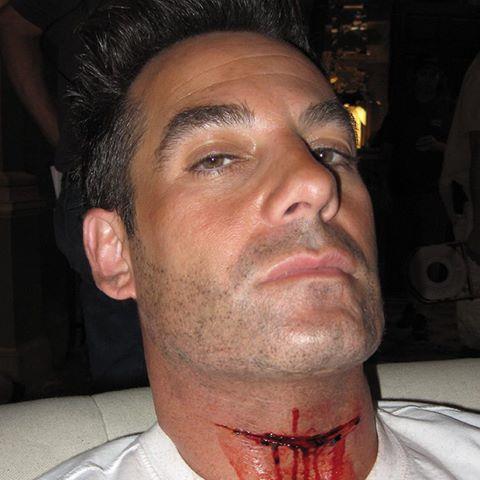
- Complete the following table regarding neck injury zones, circling the zone injured in this patient. (6 marks)
| Zone | Anatomical landmarks | Potential injuries |
| 1 | Clavicles to cricoid cartilage | Subclav artery/vein, jugular vein, common carotid artery, trachea, thyroid, oesophagus, apex lung |
| 2 | Cricoid cartilage to angle of jaw | Carotid arteries, IJV, oesophagus, larynx, cranial nerves X, XI, XII, spine |
| 3 | Angle of jaw to base of skull | Lateral pharynx, cranial nerves VII, IX, X, XI, XII, spine, carotids |
- List four absolute indications mandating immediate operative repair in neck injuries. (4 marks)
- Hard signs of vascular/significant injury: airway compromise, air bubbling from wound, expanding or pulsatile haematoma, active bleeding, shock, compromised radial pulse, haematemesis, neuro deficit/paralysis/cerebral ischaemia.
- List three soft signs of neck injury. (3 marks)
- Subcutaneous emphysema, dysphagia, venous oozing, minor haematemesis, non-pulsatile/non-expanding haematoma, chest tube air leak, paraesthesia.
- The patient is moved into resusc where he recovers from his faint. His BP is 110/80, HR 98, Sats 99%RA. Examination of the wound reveals breach of the platysma. List your next three steps in management of this patient, including consults where appropriate. (3 marks)
- Group and cross, urgent bloods – coags etc. Abx, IVT, NBM as usual. Analgesia….
- *Vascular consult
- *CTA whilst awaiting vascular consult – patient stable, will help with decision to operate or not
SAQ 2
A 48-year-old cyclist walks into triage. He had been cycling downhill at 40kph when he ran into a wire across the path that some miscreant had placed there. He was somersaulted from the bike and landed on his right-hand side. He denies LOC at the time but complains of a sore neck and chest.
- Outline your immediate steps in management of this patient. (4 marks)
- *Trauma call – level 2 – serious mechanism
- *Place patient on barouche and apply cervical collar
- Move to resuscitation room
- Urgent trauma series x-ray/bloods/etc
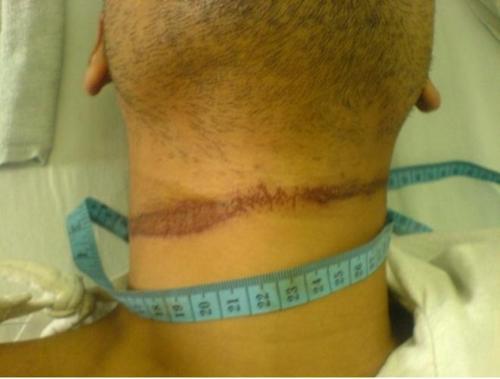
- An image of his neck injury is shown (below). What signs would suggest a laryngeal injury? (3 marks)
- Subcut emphysema, voice changes eg hoarseness, dyspnoea, haemoptysis, bubbling, stridor
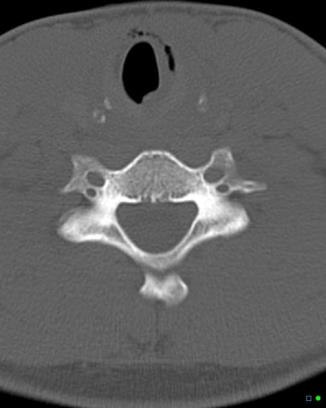
- His trauma series is negative for serious injury. You order a CT neck and obtain the following result (image below). What is the abnormality on this CT scan?
- Fracture/disruption of the larynx with free gas surrounding the larynx.
- You decide to intubate the patient pending operative repair of the injury shown in (c). RSI is performed by your eager RMO with first-pass success, confirmed by capnography. He continues to bag the patient whilst the ventilator is set up, before nervously mentioning that the patient is hypotensive and his saturations are now 88% despite increasingly vigorous bagging by the RMO.
What is the likely diagnosis? Briefly describe the likely mechanism. (3 marks)- Pneumothorax, possibly even tension PTx, secondary to overly vigorous bagging and resultant build up of air in the chest cavity from the laryngeal tear.
SAQ 3
A 65-year-old male is brought in by ambulance after an MVA. He was driving a quad bike on his farm when it overturned, landing on top of him. He self-extricated and called SAAS on his mobile. His past history includes diabetes, COPD, and hypertension. His obs on arrival are BP 130/80, HR 70, Sats 92% RA. He complains of left sided chest pain and has no other apparent injuries. His CXR on arrival is shown (image below).
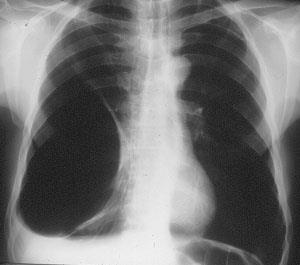
- List three findings on his CXR (positive or negative). (3 marks)
- *Large area of opacity in right lower/middle zone – ? bulla ?Ptx. Concave inner margin suggests bulla
- No ETT/no obvious fractures/no consolidation/trachea midline
- Hyperinflated lungs – underlying COPD
- You decide to insert a chest drain, using the opportunity to teach your RMO about the procedure. Briefly describe:
- The rationale for giving oxygen in patients with pneumothorax
- Oxygen washes out nitrogen from the alveoli, creating a gradient for nitrogen to diffuse from the pleural space into the lung, decreasing the size of the Ptx.
- The anatomical borders of the “safe triangle” for chest drain insertion.
- Lateral border of the pectoralis major, border of the lat dorsi, apex axilla, base 5th rib.
- The rationale for giving oxygen in patients with pneumothorax
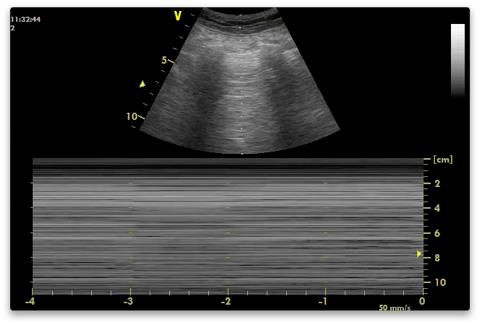
- Immediately after inserting the chest drain into the right chest, the patient becomes more dyspnoeic. You perform an urgent bedside ultrasound and obtain the following image (image below). Briefly outline what the ultrasound shows, and the likely reason for the patient’s deterioration after chest drain insertion. (3 marks).
- Ultrasound shows loss of “sandy shores” – so pneumothorax, ie no lung sliding. Patient originally had a bulla, not a Ptx (concave inner margins). Bulla likely due to his COPD. You put a chest drain through it, causing an iatrogenic Ptx. Whoops!
SAQ 4
A 24-year-old female is brought to your rural ED after an MBA. She was in full protective gear when she slipped on gravel at 80kph. She mobilised at the scene. On arrival, she is dyspnoeic and complaining of chest pain. Examination reveals paradoxical movement of her right chest wall, suggesting a flail chest.
- State the definition of a flail chest and briefly explain the clinical significance of this diagnosis. (2 marks)
- Definition: at least two fractures per rib, in at least two ribs.
- Significance: indicates underlying pulmonary contusion and can be potentially life-threatening.
- The patient remains hypoxemic despite oxygen therapy and you decide to intubate her. RSI is performed without incident. You suspect acute respiratory distress syndrome (ARDS).
- Define ARDS. (2 marks)
- An acute diffuse, inflammatory lung injury leading to increased pulmonary vascular permeability, increased lung weight and loss of aerated lung tissue…with hypoxemia and bilateral radiographic opacities, increased physiological dead space, and decreased lung compliance.
- What PaO2/FiO2 ratio defines severe ARDS? (1 mark)
- <100
- Define ARDS. (2 marks)
- CXR confirms flail chest with ARDS and excludes pneumothorax. Outline a ventilation strategy for this patient.
| Parameter | Ventilator setting |
| Mode | Volume control (VCV) |
| Tidal volume (TV) | 6-8 ml/kg |
| Respiratory rate (RR) | 16-18 /min |
| PEEP | 5 |
| Plateau pressure (mmHg) | <30 |
| Sats (%) | 88-92% |
| Inspiration:expiration ratio (I:E) | 1:2 |
| ET CO2 | High – permissive hypercapnia |
- You arrange retrieval of the patient to a tertiary centre. Do you place prophylactic chest drains or not? Justify your answer. (2 marks).
- Yes – high risk of developing a pneumothorax in flight, and will need positive pressure ventilation for her flail chest, which further increases the risk. Risk of insertion at hospital less than doing an emergent drain intra-flight.
SAQ 5
A 32 year old jockey falls off her horse during a race; the horse gallops over her abdomen. She has immediate pain in her abdomen and is unable to lie flat, preferring to remain in foetal position. She is BIBA to your tertiary ED.
- Complete the following table with pros and cons of imaging techniques in abdominal trauma.
| CT abdomen | Diagnostic peritoneal lavage | Ultrasound (FAST) | |
| Pro 1 | Anatomical information | Rapid,cheap, sensitive | Rapid, repeatable |
| Pro 2 | Views retroperitoneum | Ideal if unstable pt | Ideal if unstable pt |
| Con 1 | Time/cost/radiation | Not organ specific | Operator dependent |
| Con 2 | Not for unstable pts | False negatives | False neg/pos |
- An eFAST performed at bedside is negative. What views constitute an eFAST?
- Subxiphoid, hepatorenal, splenorenal, pelvic, bilateral upper anterior chest walls
- Her obs are BP 110/70, HR 78, Sats 100%. Urine dipstick shows microscopic haematuria, BHCG negative. What are three indications for CT with contrast in suspected genitourinary trauma?
- Gross haematuria
- Stable pt with microscopic haematuria and persistent BP<90mmHg
- Suspected renal injury or significant deceleration injury
- Her BP drops to 90/60 (asymptomatic). A repeat eFAST is negative. List three abdominal injuries that could explain her hypotension and state your next step in management.
- Bowel injury
- Pancreas injury
- Retroperitoneal injury with concealed haemorrhage
- Retroperitoneal organ injury – renal injury, ascending colon injury
- Next step: CT scan
SAQ 6
A 26 year old female ATSIC presents to ED after being stabbed in the abdomen. She is 20 weeks pregnant with her third child and says during an argument over drugs, her boyfriend stabbed her multiple times in the abdomen with a knife. They then reconciled and he drove her to ED.
- List four blood tests you will order and justify your choice.
- Kelihauer test – evaluates foeto-maternal transfer of blood
- Group and save – Rhesus factor for mother, need for anti-D, risk of haemorrhage
- Hb – bleeding, etc
- Coags – bleeding risk/LFT/EUC – any reasonable test
- List two methods for determining the presence/ severity of intra-abdominal injury in this patient and give a pro/con for each.
- CT – risk of radiation to mother, potentially unstable pt, pro: excellent anatomical information
- Ultrasound – Con: operator dependent, Pro: non-invasive and rapid
- State two non-medical actions you will have to undertake in this situation.
- *Report to police – stabbing
- CARL report – potential child at risk?
- Social work input/Aboriginal liaison
- The patient is stabilised, and states she does not want to press charges against her partner. Does this change your answer to the previous question?
- No. We are obliged by law to report any stabbing or gunshot injury, regardless of patient wishes.
- The scan ordered shows no injury to the mother, but traumatic rupture of the uterus with evidence of foetal cranial injury. List the disposition for this patient and three consults you will order, with justification.
- Obs Gynae – will need to deliver/have child delivered, non-survivable injury
- Social work – DV situation, grief counselling
- Anaesthetics – possible theatre for retrieval of foetus

