SAQ 1
A 32-year-old male presents to triage holding his neck. He tells the triage nurse that he has been stabbed, raising his hand to show the following injury (image). He then collapses to the floor.
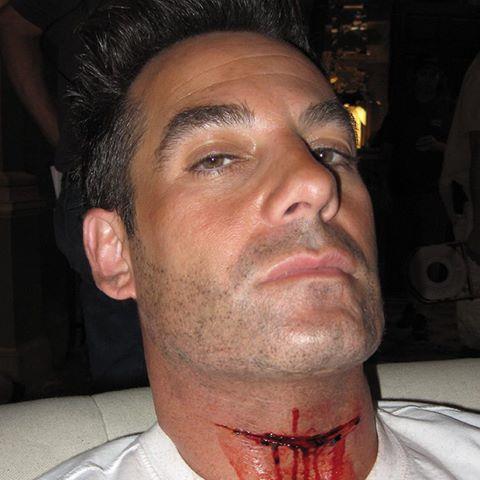
- Complete the following table regarding neck injury zones, circling the zone injured in this patient. (6 marks)
| Zone | Anatomical landmarks | Potential injuries |
| 1 | ||
| 2 | ||
| 3 |
- List four absolute indications mandating immediate operative repair in neck injuries. (4 marks)
- List three soft signs of neck injury. (3 marks)
- The patient is moved into resusc where he recovers from his faint. His BP is 110/80, HR 98, Sats 99%RA. Examination of the wound reveals breach of the platysma. List your next three steps in management of this patient, including consults where appropriate. (3 marks)
SAQ 2
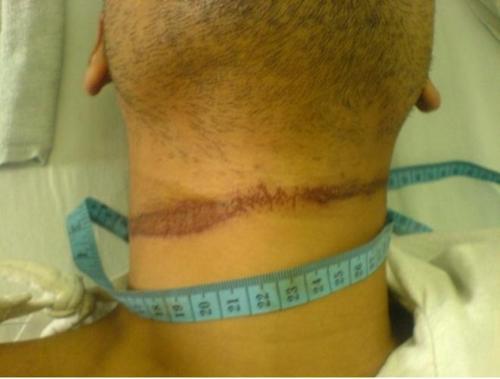
A 48-year-old cyclist walks into triage. He had been cycling downhill at 40kph when he ran into a wire across the path that some miscreant had placed there. He was somersaulted from the bike and landed on his right-hand side. He denies LOC at the time but complains of a sore neck and chest.
- Outline your immediate steps in management of this patient. (4 marks)
- An image of his neck injury is shown (below). What signs would suggest a laryngeal injury? (3 marks)
- His trauma series is negative for serious injury. You order a CT neck and obtain the following result (image below). What is the abnormality on this CT scan?
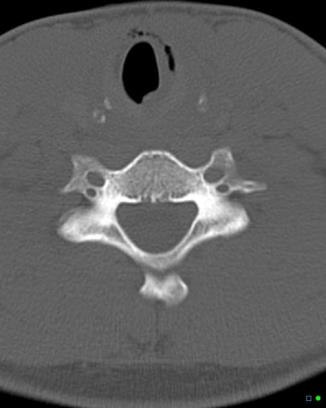
- You decide to intubate the patient pending operative repair of the injury shown in (c). RSI is performed by your eager RMO with first-pass success, confirmed by capnography. He continues to bag the patient whilst the ventilator is set up, before nervously mentioning that the patient is hypotensive and his saturations are now 88% despite increasingly vigorous bagging by the RMO.
What is the likely diagnosis? Briefly describe the likely mechanism. (3 marks)
SAQ 3
A 65-year-old male is brought in by ambulance after an MVA. He was driving a quad bike on his farm when it overturned, landing on top of him. He self-extricated and called SAAS on his mobile. His past history includes diabetes, COPD, and hypertension. His obs on arrival are BP 130/80, HR 70, Sats 92% RA. He complains of left sided chest pain and has no other apparent injuries. His CXR on arrival is shown (image below).
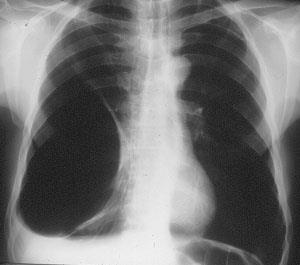
- List three findings on his CXR (positive or negative). (3 marks)
- You decide to insert a chest drain, using the opportunity to teach your RMO about the procedure. Briefly describe:
- The rationale for giving oxygen in patients with pneumothorax
- The anatomical borders of the “safe triangle” for chest drain insertion.
- Immediately after inserting the chest drain into the right chest, the patient becomes more dyspnoeic. You perform an urgent bedside ultrasound and obtain the following image (image below). Briefly outline what the ultrasound shows, and the likely reason for the patient’s deterioration after chest drain insertion. (3 marks).
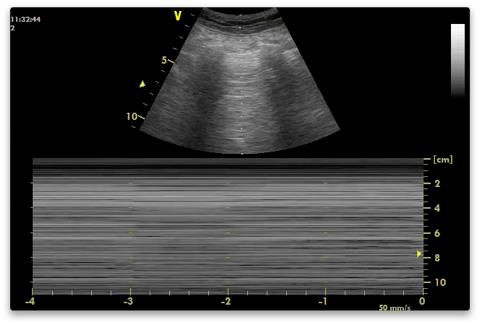
SAQ 4
A 24-year-old female is brought to your rural ED after an MBA. She was in full protective gear when she slipped on gravel at 80kph. She mobilised at the scene. On arrival, she is dyspnoeic and complaining of chest pain. Examination reveals paradoxical movement of her right chest wall, suggesting a flail chest.
- State the definition of a flail chest and briefly explain the clinical significance of this diagnosis. (2 marks)
- The patient remains hypoxemic despite oxygen therapy and you decide to intubate her. RSI is performed without incident. You suspect acute respiratory distress syndrome (ARDS).
- Define ARDS. (2 marks)
- What PaO2/FiO2 ratio defines severe ARDS? (1 mark)
- CXR confirms flail chest with ARDS and excludes pneumothorax. Outline a ventilation strategy for this patient.
| Parameter | Ventilator setting |
| Mode | |
| Tidal volume (TV) | |
| Respiratory rate (RR) | |
| PEEP | |
| Plateau pressure (mmHg) | |
| Sats (%) | |
| Inspiration:expiration ratio (I:E) | |
| ET CO2 |
- You arrange retrieval of the patient to a tertiary centre. Do you place prophylactic chest drains or not? Justify your answer. (2 marks).
SAQ 5
A 32 year old jockey falls off her horse during a race; the horse gallops over her abdomen. She has immediate pain in her abdomen and is unable to lie flat, preferring to remain in foetal position. She is BIBA to your tertiary ED.
- Complete the following table with pros and cons of imaging techniques in abdominal trauma.
| CT abdomen | Diagnostic peritoneal lavage | Ultrasound (FAST) | |
| Pro 1 | |||
| Pro 2 | |||
| Con 1 | |||
| Con 2 |
- An eFAST performed at bedside is negative. What views constitute an eFAST?
- Her obs are BP 110/70, HR 78, Sats 100%. Urine dipstick shows microscopic haematuria, BHCG negative. What are three indications for CT with contrast in suspected genitourinary trauma?
- Her BP drops to 90/60 (asymptomatic). A repeat eFAST is negative. List three abdominal injuries that could explain her hypotension and state your next step in management.
SAQ 6
A 26 year old female ATSIC presents to ED after being stabbed in the abdomen. She is 20 weeks pregnant with her third child and says during an argument over drugs, her boyfriend stabbed her multiple times in the abdomen with a knife. They then reconciled and he drove her to ED.
- List four blood tests you will order and justify your choice.
- List two methods for determining the presence/ severity of intra-abdominal injury in this patient and give a pro/con for each.
- State two non-medical actions you will have to undertake in this situation.
- The patient is stabilised, and states she does not want to press charges against her partner. Does this change your answer to the previous question?
- The scan ordered shows no injury to the mother, but traumatic rupture of the uterus with evidence of foetal cranial injury. List the disposition for this patient and three consults you will order, with justification.

