SAQ 1
A 68 yo female with rheumatoid arthritis presents with an acutely painful right knee. She is on low dose prednisolone and NSAIDS. Her temperature is 37.9°C.
- List four differential diagnoses for her presentation. (4 marks)
- *Septic joint – must have to pass.
- Bursitis
- Gout
- Reactive arthrisis
- Osteomyelitis
- Cellulitis
- For the most time critical diagnosis in your list, give three examination findings you will seek and briefly justify how they will confirm/exclude this diagnosis. (3 marks)
- ROM – pain on passive movement makes septic joint more likely
- Fever – septic joint/infection more likely
- UTWB – septic joint more likely
- Complete the following table for results of knee aspiration. (6 marks)
| Infectious | Inflammatory | Non-inflammatory | |
| White cell count/mm3 | >50,000 | 2000-50,000 | <2000 |
| Culture | Positive | Negative | Negative |
| Crystals | Nil | Positive | Nil |
| Colour | Grey/turbid | Yellow/milky | Straw |
| PMN % | >75% | >50% | <25% |
- Her joint aspirate returns a WCC of 70,000 with 85% PMNs. Are steroids indicated? Justify your answer. (2 marks).
- Likely septic arthritis – no evidence of steroids being useful in septic arthritis in ADULTS. Children may benefit, based on two small studies, but evidence is lacking for use of steroids in adult septic arthritis.
SAQ 2
A 36 year old male presents with 2 days of pain and swelling to both his left knee and his right elbow.
- State four questions you will ask on history taking given this presentation. (4 marks)
- *Sexual history
- *Alcohol history
- Rheumatological history
- Trauma
- Immunosuppression/DM/other reasonable history
- State three risk factors for a septic joint in any patient. (3 marks)
- Immunosuppression
- Diabetes
- Previous joint replacement
- Rheumatoid arthritis
- IVDU/bacteremia/liver disease/cancer/etc etc
- The patient has no history of trauma and is afebrile on examination. He is able to move the joint with only mild reduction in range of movement. You decide to aspirate joint fluid. State three contraindications to joint aspiration. (3 marks)
- Localised infection over area of aspiration
- Previous surgery to area, particularly joint replacement
- Coagulopathy
- No effusion present/systemic bacteremia/patient refusal/etc
- Briefly describe how you will aspirate one of the two joints involved. Specify your anatomical landmarks. (4 marks)
- Knee aspiration: Knee joint at 150. Medial approach. Insert needle inferior to the patella, 1 cm inferior to the femoral condyle, anterior to the tibial plateau. Milk suprapatellar pouch whilst aspirating.
- Elbow aspiration: sit patient upright. Position arm by the side with internal rotation of arm. Needle inserted horizontally, inferior and lateral to the coracoid process. Direct needle posteromedially towards the glenoid.
- Aspirate fluid reveals negatively birefringent crystals with no bacteria seen. Briefly state the diagnosis and two appropriate treatments for this condition. Doses are not required. (3 marks)
- Negatively birefringent crystals – gout. Pseudogout would have positively birefringent crystals (remember the Ps – Pseudogout Positive birefringent calcium Pyrophosphate). Treatment is NSAIDS or steroids. Colchicine is an option, but less used due to toxicity concerns.
Fail question if suggest allopurinol – use of urate lowering drugs is not helpful in acute gout, only for prevention.
- Negatively birefringent crystals – gout. Pseudogout would have positively birefringent crystals (remember the Ps – Pseudogout Positive birefringent calcium Pyrophosphate). Treatment is NSAIDS or steroids. Colchicine is an option, but less used due to toxicity concerns.
SAQ 3
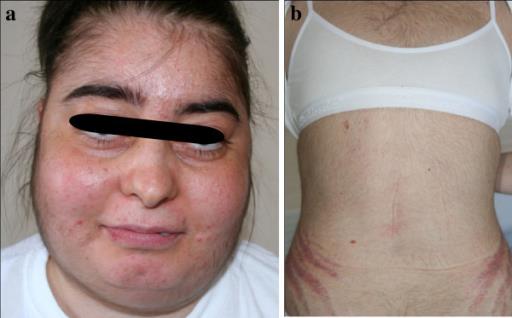
A 60 year old female presents with 2 days of progressive difficulty in getting up from her chair. Her PMHx is significant for end stage asthma. Examination of legs reveals 4/5 proximal symmetrical weakness of both legs, with brisk reflexes and no sensory deficits. An image of the patient is shown below.
- State three differential diagnoses you would consider in this patient. (3 marks)
- *Steroid myopathy
- Hypothyroidism
- Paraneoplastic syndrome/hypokalaemia/any other reasonable
- PMR is possible, but less likely as it improves with steroids.
- List four tests you will order and briefly justify your reason. (4 marks)
- CK – exclude rhabdomyolysis
- Cortisol level – exclude/confirm hypercortisolemia
- EUC – potassium level etc
- ESR/CRP – significant elevation in rheumatological disease
- Muscle biopsy/LSp xray/any other reasonable.
- (unfair question?) For the most likely diagnosis, state two management options. (2 marks)What two treatments will you now initiate?
- Increase dietary protein. Decrease steroids – e.g. alternate day dosing. Physiotherapy.
SAQ 4
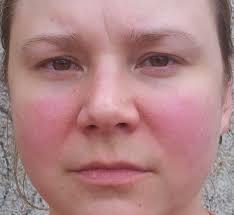
A 28 year old female presents to ED with 24 hours of dyspnoea. She reports a 3 year history of Raynaud’s disease, polyarthralgia, and migraine. VQ scanning confirms a PE and appropriate treatment is commenced. An image of the patient is shown below.
- List and justify three blood tests you will order for this patient. (3 marks)
- ANA, anti dsDNA, C3/C4 levels, antiphospholipid antibodies – to confirm lupus.
- List three systems affected by this condition and an example of a manifestation in each system. (3 marks)
- Renal – renal impairment due to deposition of complexes
- Skin – malar rash, discoid lesions, other
- Musculoskeletal – arthritis,
- Haematological – anaemia, leukopaenia, thrombocytopaenia
- CVS – pericarditis, endocarditis
- Resp – pleuritis, PE, pneumonitis
- State two treatment options for this condition (doses are not required). (2 marks)
- Steroids, hydroxychloroquine, plaquenil, azathioprine
- The patient asks you whether her pulmonary embolus and Raynaud’s disease are related to this condition. How do you answer her? (2 marks)
- Patients with one autoimmune disorder are more prone to other autoimmune, particularly females (who express constitutively higher levels of interferon gamma, a pro-inflammatory cytokine involved in Th1 cell behaviour). Raynaud’s is strongly associated with lupus. Her PE is likely due to antiphospholipid syndrome secondary to lupus.
SAQ 5
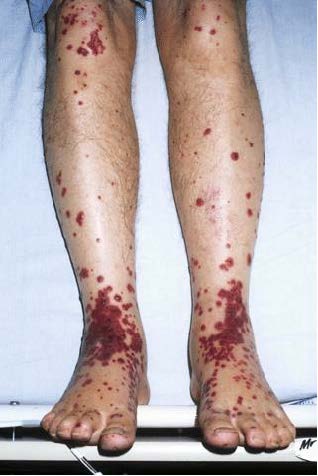
A 70 year old male currently receiving chemotherapy for colorectal cancer (Duke’s B) presents with a 3 hour history of a rash (image shown). He feels otherwise well, and states the rash is not itchy or painful. He is on no other medications aside from the chemotherapy and has been well except for a dry cough. He has no other past medical history.
- List four differential diagnoses for this rash. (4 marks)
- *Meningitis – must include
- Drug reaction
- HSP, other vasculitis-es
- DIC/coagulopathy/platelet dysfunction
- On examination, you notice the rash is palpable. Does this assist in differential diagnosis, and how? (2 marks)
- Palpable purpura implies vessel inflammation, so vasculitis is more likely. Non-palpable purpura occurs in platelet disorders where the vessel is normal but platelets are misbehaving (eg ITP, HSP).
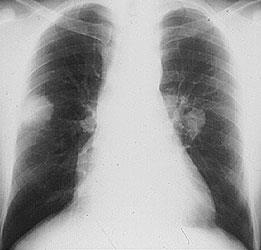
- Meningitis is excluded based on a negative LP and negative blood cultures. A CXR is ordered and is shown. Describe the main abnormality on the x-ray and how this clarifies diagnosis in this patient. (2 marks)
- Well circumscribed lesion in right middle lobe. In clinical context, possible Wegener’s lesion.
- State two medications that may be used to treat this patient (do not include dose), and a possible side effect of each. (2 marks)
- Steroids – osteoporosis, mental changes, Cushing’s etc etc
- Methotrexate – hepatotoxicity, leukopaenia, ulcerative stomatitis, renal/pulmonary…
- Upon discharge, list two clinical signs/symptoms that the patient should be aware of as requiring immediate return to hospital.
- Haemoptysis, haematuria, dyspnoea (pleural effusion)

