SAQ 1
For each of the following patients, state whether permissive hypotension (hypotensive resuscitation) is appropriate and give a reason for your answer.
- An 18-year-old unrestrained male driver involved in a rollover MVA where he was ejected from the car. On arrival, BP 100/60, HR 120, GCS 6/15. FAST scan positive.
- Contraindicated. GCS low and not explained by BP/HR. Likely head injury – TBI is contraindication.
- 34-year-old female, currently 16/40 pregnant, presents with significant stab wound to abdomen secondary to domestic violence. BP 80/60, HR 110.
- Indicated: risk to child irrelevant given gestational age. Mother has penetrating trauma and may benefit from permissive hypotension prior to emergent surgery.
- 92-year-old female from a HLCNH. Suffered an unwitnessed fall down stairs at NH. GCS 9/15, BP 110/60, HR 130 irregular. Tense, rigid abdomen on examination.List two consults you will request for this patient and justify each. (2 marks)
- Contraindicated. Elderly, HLCNH, likely head injury.
SAQ 2
- List three indications for therapeutic hypothermia in cardiac arrest.
- Non-traumatic cardiac arrest with ROSC
- Comatose (GCS <8)
- Age 18-75 years
- Briefly describe how you would achieve temperature reduction in therapeutic hypothermia.
- Give rapid infusion of 4° normal saline over two hours at 30mlkg (ie 2L).
- For each of the following, circle whether therapeutic hypothermia is indicated or contraindicated. Assume each patient has achieved ROSC after an out of hospital arrest.
- In terms of prognosis post cardiac arrest, give one clinical sign (if one exists) that suggests poor outcome after:
| Pregnancy | Indicated | Contraindicated |
| Terminal illness | Indicated | Contraindicated |
| ROSC <60 mins | Indicated | Contraindicated |
| Uncontrolled arrhythmia | Indicated | Contraindicated |
| Initial temperature >30 | Indicated | Contraindicated |
| Coagulopathy | Indicated | Contraindicated |
| Initial arrest PEA/asystole | Indicated | Contraindicated |
- In terms of prognosis post cardiac arrest, give one clinical sign (if one exists) that suggests poor outcome after:
- Cardiac arrest with NO therapeutic hypothermia
- No clinical signs reliable in <24 hours post arrest. After 72 hours, absent pupil light and corneal reflexes suggest poor outcome if no confounders (eg low BP, sedatives)
- Cardiac arrest WITH therapeutic hypothermia
- No clinical signs reliable in <25 hours. Even after 24 hours, no single parameter is accurate. Potential options include poor EEG, absent corneal reflexes after 72 hours.
- Cardiac arrest with NO therapeutic hypothermia
SAQ 3
A 35 year old male with no past psychiatric history is brought in by SAPOL netted after being violent towards his parents. He is taken to the resuscitation room upon arrival. His BP is 140/90, HR 145, Sats 99% RA, RR 30 and T 39°C.
- List five medications/toxins that could explain his presenting symptoms.
- Amphetamines
- Anticholinergics
- Cocaine
- MAO inhibitors
- Salicylates
- Serotonin syndrome
- List three investigations you will order immediately, with justification for each.
- ECG – arrhythmia secondary to ingestion
- CK – rhabdo secondary to medication
- Salicylate level if indicated
- BGL – low in salicylate toxicity
- Upon further questioning, you discover he suffers from migraine and has been self-treating a persistent migraine for the last few days. His blood gas is as follows:
pH 7.48
CO2 29
O2 155
HCO3 17
Na 142
Cl 100
K 3.2
Glu 2.4
Describe and interpret the ABG.- Primary respiratory acidosis with partial compensation with metabolic alkalosis. Concurrent HAGMA. Likely salicylate poisoning (triple disorder).
- What two treatments will you now initiate?
- Urinary alkalinisation with sodium bicarbonate, aim pH >7.5
- Glucose infusion – hypoglycaemia – aim BGL>4
SAQ 4
A 42-year-old female doctor is brought to ED after completing a January marathon. She is confused and agitated. Her BP is 100/60, HR 36, and T 37.2°C (axilla). She is taken to the resuscitation room on arrival. Her ECG is shown below:
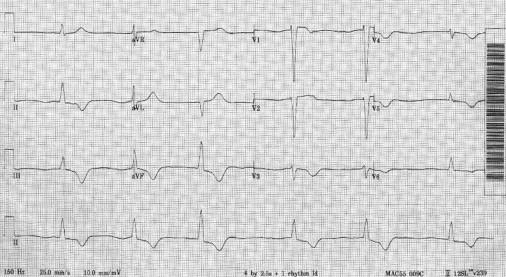
- List three abnormalities on the ECG and give a likely diagnosis for her presentation.
- Long QT interval (most common change in both hyper and hypothermia)
- AF
- TWI
- Bradycardia
Diagnosis: heatstroke
- List three ECG changes seen in severe hyperthermia.
- QT prolongation
- AF/SVT
- Conduction defects – RBBB etc
- Her core temperature is measured in ED at 41.5°. You decide to initiate cooling. Briefly describe the difference between the following methods of cooling:
Conduction
passive heat diffusion, direct conduction
Convection
eg wind removing heat as it passes over body
Radiation
passive loss of heat from non-insulated areas body - List two complications of heatstroke or its treatment, and how you will prevent/treat the complication.
- Rhabdomyolysis – fluid resuscitation with U/O >1ml/kg/hr
- Seizures/shivering – will increase temperature – use benzodiazepines

