SAQ 1
A 17 yo male is brought into your rural ED following a high speed MVA. He is hypotensive and tachycardic. You are struggling with access.
- Give three options for gaining access in this patient, with a pro and con for each.
| Access option | Pro | Con |
| Ultrasound guided, high freq probe 7.5-10mHz | Rapid venous access | Operator dependent, may be too shut down for success |
| IO access – tibia, humerus | Rapid, high rate of success | Pain, contraindications, not as rapid IV fluid administration |
| Central line | Allows administration of vasopressors/potent drugs | Requires specialised training, risk of PTx, etc |
- You arrange transfer to the nearest tertiary centre (four hours away by flight) and consider hypotensive resuscitation as an option. What is the proposed pathophysiological benefit of hypotensive resuscitation in trauma patients?
- Theory: lower pressures reduce clot removal and shear forces, so decrease bleeding.
- For this patient, list four reasons why hypotensive resuscitation is not appropriate.
- Hypotensive resuscitation is primarily applicable to penetrating trauma rather than blunt trauma
- Based on animal studies – may not be applicable to humans
- Risks decreased perfusion to vital organs (brain, heart)
- Risky if long retrieval times, eg in Australia
- Risk of missing serious causes of hypotension (eg pneumothorax).
- *currently no evidence to suggest hypotensive resusc should be standard practice
- You manage to place an IO in the medial tibia and extract bloods for pathology. Circle which of the following tests from an intraosseous sample will be equivalent to those from a normal venous sample.
| Hb | WCC | Na | K | glucose | HCO3 | pH | CO2 | O2 | blood group |
SAQ 2
A 23 yo male is BIBA after being involved in a street brawl nearby. He is GCS 6, BP 90/60, HR 125bpm. His main injury is shown (image). He is also bleeding profusely from a deep laceration to the left upper arm.
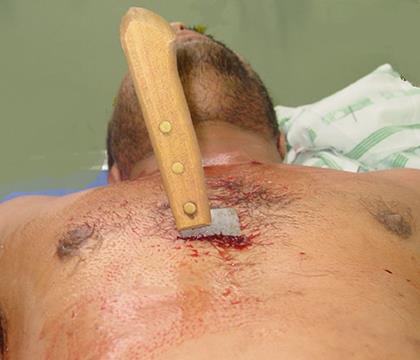
- List five steps in your immediate management.
- Move to resuscitation room
- Leave knife in situ – do NOT remove
- Pressure dressing to left upper arm
- ETT with RSI (any drug choice, ROCKET, sux, etc) – GCS 6
- Chest tube right thorax
- FAST scan
- List four injuries you anticipate from the main injury shown.
- Right ventricular injury – RV is closest to sternum/anterior thorax
- Lung injury – PTx likely
- Injury to vessels/aorta/etc
- Injury to abdominal organs – stomach, oesophagus
- Give two indications for ED thoracotomy in the following circumstances:
- Penetrating thoracic trauma
- Previous witnessed cardiac activity in ambulance or ED
- Unresponsive hypotension despite resuscitation (BP<70mmHg)
- Blunt thoracic trauma
- Rapid exsanguination from chest tube (>1500ml)
- Unresponsive hypotension despite resuscitation (BP<70mmHg)
- Penetrating thoracic trauma
- You insert a chest drain into the right thorax. Outline your technique for chest drain insertion.
- Consent where appropriate (not here!), PPE and sterile technique
- Locate landmark – 4th or 5th ICC MAL
- LA – infiltrate as you go, checking with aspiration first to ensure no vessel injured
- Horizontal incision over rib 4 or 5
- Blunt dissection with fingers/forceps
- Insert drain to 4-5m past last drainage hole. Use 32 Fr size.
- Mattress suture in place, dressing
- Attach USWD
- The chest drain produces an immediate result of 990 ml frank blood. Complete the following lines regarding indications for immediate thoracotomy in chest trauma.
Immediate blood loss from chest tube of 1500 ml
Loss of 400 ml per hour for hours after chest drain insertion.
SAQ 3
A 70-year-old male presents to your community ED with 24 hours of chest pain. The pain is similar to that he had 12 months ago with an MI, for which he had thrombolysis. He is on aspirin and clopidogrel. His ECG today shows a new anterior MI.
- List 8 contraindications to thrombolysis in acute MI.
- New neurological deficits
- Pericarditis
- Seizures
- Previous haemorrhagic CVA
- Ischaemic CVA in last 3 months
- Suspected aortic dissection
- Brain tumour
- Active bleeding (not menses)
- Head/facial trauma in last 3 months
- For this patient, give a pro and con for each of the following management options for his acute MI.
Thrombolysis
Pro: available at community ED, beneficial if delay to PCI
Con: increased risk of allergic reaction/adverse event given previous thrombolysis
Percutaneous coronary intervention
Pro: greatest benefit in patients >70 and pts with longer time to presentation
Con: not likely to be available at community ED - You decide to administer thrombolysis to this patient pending transfer to a tertiary centre. Give the drug, dose, and administration details below.
- tPA – 0.9mg/kg. Give 10% over 10 minutes, then remainder over the next hour. Max dose 90mg.
- Half an hour into thrombolysis, your patient complains of a headache and an inability to use his smartphone as his right hand won’t move. List five management steps you will immediately undertake.
- Likely ICH and obsession with his smart phone. Management steps:
- Stop tPA infusion
- Urgent bloods, particularly cross match
- FFP 2 units
- Cryoprecipitate 10 units
- TXA 1g IV
- Platelets – on antiplatelet agents
- Also consider urgent CT and usual management for raised ICP (30degrees, mannitol etc).
- Likely poor prognosis.
SAQ 4
A 36 year old skier is brought to ED by rescue paramedics. He had been found unconscious in a wooden area of the ski field. On arrival, he has a BP of 110/70, HR of 55 (irregular). He is localising pain, opening his eyes to voice, and is confused.
- What is his GCS?
- E3/V3/M5. GCS is 11.
- List five differential diagnoses for his presentation.
- Hypothermia
- Trauma with head/c-spine injury
- Alcohol intoxication/drug intoxication
- Drug overdose
- Assault
- Pre-existing medical condition, eg seizure disorder, MI, hypoglycaemia.
- His core temperature is 26°C. You diagnose likely hypothermia with no other significant injury. Complete the following table of rewarming options with rate of rewarming expected in each method.
| Technique | Temperature rise per hour (°C) |
| Endogenous warming (warmed IVT) | 1 |
| Forced air warming device (Bair Hugger eg) | 1-2 |
| Peritoneal lavage | 2-4 |
| ECMO | 7-10 |
- Complete the following regarding CPR in hypothermic patients.
Continue CPR until temperature 32 °C unless life threatening injuries present
Main therapeutic intervention: active rewarming
Defibrillate VF/VT only if temperature >30 °C
ALS drugs – administer after temperature reaches 30 °C
The interval between drugs should be doubled until temperature reaches 32 °C.
SAQ 5
A 2 year old child presents by ambulance with 50% burns TBSA to the lower half of the body only, sustained an hour ago. First aid was provided by SAAS on arrival at the scene, and the child was intubated prior to transport. She is taken to resuscitation on arrival.
- Describe the fluid requirements of this child, showing calculations where appropriate.
- *Parklands formula – 4ml/kg * TBSA.
- Est weight 12 kg (age + 4 *2) x 4 x 50 = 2400ml Hartmanns
- Give half in first 8 hours after burn (note: one hour has elapsed), remainder over 16 hours.
- *Add maintenance for child under 30kg – 4:2:1 rule. 44ml/kg of Hartmanns.
- IV access is difficult, so an IO is inserted. List 5 complications of IO access.
- Growth plate injury
- Through and through penetration
- Haematoma
- Compartment syndrome
- Growth plate injury
- Infection
- Briefly outline the method of IO access in this child.
- Locate landmark – sternal or upper humerus in this child
- Apply chlorhex or similar
- Use IO and drill in
- Secure IO and flush
- **automatic fail if suggests tibia as possible spot – patient has burns in area, contraindicated.
- List 6 indications for transfer to a burns unit in any burns patient.
- Circumferential burns
- Chemical/electrical burns
- TBSA >5% child, >10% adult
- Full thickness burns >5% TBSA in any age
- Special area burns – facial, feet, hands, genitals
- Significant comorbidities/elderly/pregnant/very young patients
- Suggestion of NAI
- List two other management options required in this particular case.
- Likely immersion burn – mandatory notification of possible child abuse
- Tetanus prophylaxis/analgesia/IDC for strict urine output
SAQ 6
A woman presents to your ED at 130am in the second stage of labour. A precipitous delivery ensues with rapid delivery of a male neonate. The baby is blue and floppy.
- Outline your immediate resuscitation of this child.
- Manual stimulation with towel
- Suction mouth/nose
- Ventilate with PPV with 40-60 breaths per minute
- CPR 1:3 ratio if HR <100bpm
- Glucose 2-5ml/kg if BGL<4
- What are the components of the APGAR score?
- Heart rate (pulse)
- Respiratory effort (respiration)
- Muscle tone (activity/tone)
- Reflex irritability (grimace, response to stimulation)
- Colour (appearance)
- Complete the following table regarding ALS doses used in children.
| Drug/intervention | Dose/kg |
| Defibrillation | 4J |
| Adrenaline | 10mcg |
| Atropine | 20mcg |
| Bicarbonate | 1mmol |
| Adenosine | 0.1mg |
| Fluid bolus (normal saline) | 20ml |
| Magnesium | 0.1mmol |

