SAQ 1
A 6 year old child is brought to ED by her mother with nausea and vomiting. She had been seen in ED two days prior and treated for an acute exacerbation of asthma. The child is weak and pale, with a respiratory rate of 36/min and pulse rate of 140bpm. Skin turgor is poor. She is moved to a resuscitation room and IV access established. Her VBG is shown below.
pH 7.05
CO2 7
O2 28
HCO3 8
BE -20
Na 133
K 5.2
CL 98
BGL 28
- List four findings on the blood gas with a brief explanation for each. (4 marks)
- Outline your management of this child in order, giving calculations and endpoints where appropriate. (8 marks)
- Three hours after initiating treatment, the child is haemodynamically stable. The nurse mentions to you that the child is now confused and complaining of a headache. Outline your diagnosis and management. (3 marks)
- Apart from the standard blood tests ordered in ED, state three blood tests you would consider ordering for this patient given this is her first presentation with this condition. (3 marks).
SAQ 2
A 22 year old male with type 1 diabetes presents to ED with DKA. His BP is 80/40, HR 120bpm, and RR 24. He is afebrile and otherwise well.
- State three criteria for diagnosis of diabetes in a patient. (3 marks)
- Briefly describe the two pathophysiological mechanisms causing his dehydration. (2 marks)
- List five precipitants of DKA in any diabetic patient. (5 marks)
- Blood tests reveal a HbA1C level of 9.6. What is the significance of this in this patient? (2 marks)
- List four complications of DKA and how you will treat each. Doses are not required. (4 marks)
SAQ 3
A 66 year old female from home is brought in by ambulance with decreased sensorium. She had been unwell for three days with abdominal pain, nausea, and vomiting. On arrival, her HR is 130, BP 90/40, T 37.4°C, and RR 18. Sats 99% on air. She has no regular medications except for frusemide and calcitonin. A fingerprick ketone test is negative. A VBG taken on arrival is shown.
pH 7.30
CO2 30
O2 27
HCO3 15
Na 155
K 3.3
CL 98
BGL 40
Urea 7
Creatinine 150
Lactate 6.2
- Describe the major abnormalities on the blood gas, giving the most likely diagnosis. (6 marks)
- Complete the following table regarding differences between DKA and HHNS. (7 marks)
| DKA | HHNS | |
| Ketones present? | ||
| Length of prodrome | ||
| Mortality | ||
| Deficit causing illness | ||
| Severity of fluid deficit | ||
| Age of patient | ||
| Prevalence |
- How does treatment of HHNS differ from DKA? (2 marks)
- Give a likely cause of her presenting complaint, based on the information given. (1 mark)
SAQ 4
A 63 year old male presents to ED with nausea, vomiting, and abdominal pain for three days. He denies ingestion of any toxins or drugs during that time and has had poor oral intake due to ongoing intractable nausea. His GCS is 15/15, BP 110/60, HR 90, T 35°C. Blood tests taken on arrival are shown.
pH 7.22
CO2 29
HCO3 11
Na 131
K 4.3
CL 90
BGL 7.1
Urea 7
Creatinine 90
Bili 23
GGT 85
ALP 150
ALT 60
AST 80
Lipase 50
Ketones
BHB:acetoacetate ratio
8:1
- List the major findings on the blood tests and give a likely diagnosis. (6 marks)
- State four treatments indicated for this patient (doses and endpoints not required). (4 marks)
- Soon after commencing treatment, your intern tells you he accidentally gave the patient 15 units of actrapid. The patient now has a BGL of 2.0 and a decreased GCS. State a medication you will give the patient and justify your choice. (2 marks)
SAQ 5
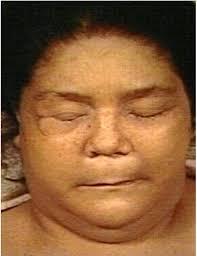
A 72 year old female is brought in by ambulance after concerned family members found her at home in a stuporous state. She has a past history of IHD, Coeliac disease, and bipolar disorder. Her regular medications are amiodarone and lithium. On arrival, she is moved to the resuscitation room. Her BP is 109/64, HR 46 sinus, T 31.2°C, and BGL 3.9. Her GCS is 10/15. Bloods taken on arrival are shown, as is an image of the patient.
pH 7.23
CO2 64
O2 71
Na 128
K 5
CL 90
BGL 3.9
Urea 7
Creatinine 150
- What is the likely diagnosis? (1 mark)
- List four treatments indicated for this patient. Doses are not required. (4 marks)
- The patient improves during a lengthy stay in AMU (after endocrine refused admission) and her lithium is ceased. Two weeks after discharge, she returns via ambulance with a complaint of agitation. Her BP is 210/100, HR 130, T 37.8°C, and RR 24. She denies intoxication or ingestion and has been complaint with her medications. List four medications you will give her in order of administration. Doses are not required, but desirable. (4 marks)
- State two possible causes for her second presentation, with justification. (2 marks)

