SAQ 1
- List three broad causes of anaemia and give two examples of each. (6 marks)
- Increased loss – GI haemorrhage, multitrauma
- Increased destruction – sickle cell anaemia, haemolysis
- Decreased production – myelodysplasia, aplastic anaemia, nutritional deficiency
- For each of the following parts of the coagulation system, state a blood test that measures each. (3 marks)
| Intrinsic pathway | APTT |
| Extrinsic pathway | PT/INR |
| Fibrinolytic system | D dimer/fibrinogen |
- For each of the following, briefly state a method of reversal in the event of life-threatening haemorrhage. Doses are not required. (4 marks)
| Warfarin | Vit K/4 units FFP/PTx |
| Heparin | Protamine 1mg/100units heparin |
| Dabigatran | Dialysis/Idarucizumab |
| Aspirin/clopidogrel | Platelet transfusion/desmopression |
- Complete the following table regarding blood products. (8 marks)
| Product | An indication for giving? | Complication of giving | Type specific needed? |
| PRBC | Hb< 70 | Iron overload | Yes |
| Platelets | Thrombocytopenia | TRALI | Yes |
| FFP | Angioedema | TRALI/overload | (yes) |
| Cryoprecipitate | DIC | TRALI/overload etc | (yes) |
- List three factors that may affect PT/INR in a patient on warfarin. (3 marks)
- Vitamin K deficiency
- Warfarin overdose
- Liver disease
- Lupus anticoagulant
SAQ 2
A 33 year old female presents with two days of a non-palpable purpuric rash (shown) and gingival bleeding. She has no other symptoms. She has been well recently and takes no regular medications except PRN aspirin/NSAIDS for migraines and endometriosis. Her LMP was 3/52 ago.
Blood tests are ordered:
Hb 120
WCC 8
Plat 60
CRP 3
Creat 90
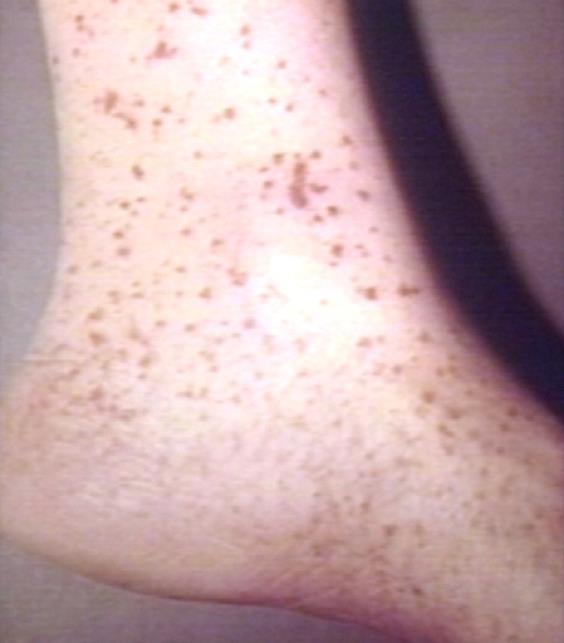
- What is the likely diagnosis? (1 mark)
- ITP (idiopathic thrombocytopaenic purpura)
- List three management options in order of administration. (3 marks)
- Steroids
- IvIg
- Platelets AFTER the above – otherwise platelets will just be destroyed
- What two pieces of advice will you give the patient? (2 marks)
- Cease NSAIDS/aspirin – antiplatelet effect
- Likely benign course of illness
- Return if bleeding problems – particularly menses, as has history of endometriosis.
SAQ 3
A 26 year old female who is currently 18/40 pregnant presents with fatigue and fever. She assumed it was due to her pregnancy, but was brought in by her husband after developing an acute right facial droop and confusion. She is G1:P0 and has no past medical history. Blood tests are taken (below).
Hb 92
WCC 12
Plat 15
Haptoglobins 15 (41-165mg/dL)
Urea 12
Creatinine 210
- List three differential diagnoses for her symptoms. (3 marks)
- *TTP, ITP, DIC, HELLP, malignant hypertension
- A CT scan is negative for acute pathology and her LFTs are normal. List three management options (curative or supportive) you could initiate for her condition. (3 marks)
- Plasmapheresis
- FFP/RBC transfusion
- Haemodialysis for renal failure
*Fail question if suggest platelet transfusion – will worsen clotting process.
SAQ 4
A 40 year old female with metastatic breast cancer presents febrile at 39.5˚C. She had chemotherapy seven days ago. Physical examination is unremarkable.
- List five investigations you will order for this patient and a justification for each. (5 marks)
- Blood cultures x 2 – 2 different sites – patient high risk for occult bacteremia
- FBE/EUC etc with differential – to confirm patient is neutropaenic
- CXR – septic screen, exclude chest source
- Urine MCS/BHCG/swabs/Sputum MCS/ECG for pericarditis/PICC line culture
- Her WCC is 2.0 with a neutrophil count of 0.7. What is the definition of febrile neutropaenia? (2 marks)
- Fever >38.5 C (oral temp) in patient under chemotherapy, with neutrophil count <0.5 × 10⁹/l or likely to drop to <0.5.
- Assuming the patient has no allergies and otherwise normal bloods, state two antibiotics you will give. Include dose, route, and the type of organism each will cover. Specific organisms are not necessary but ideal (4 marks)
- Tazocin 4.5g IV – covers gram positive and negative bacilli, and pseudomonas
- Gentamicin 5-7mg/kg – covers urine organisms and ESCAPPM organisms (Enterobacter, Serratia, etc)
SAQ 5
A 60 year old male presents with 4 day history of bleeding gums, ecchymoses, fatigue, and bone pain. His observations are normal. Examination reveals no hepatosplenomegaly. Blood tests are ordered and show:
Hb 134
WCC 43; lymphocytes 80%
Plat 107
INR 1.92
D dimer >4
- State his likely diagnosis and the complication arising from this. (2 marks)
- Acute leukaemia (AML or APL) with secondary DIC
- List 6 causes of DIC. (6 marks)
- Hepatic
- Obstetric
- Trauma
- Malignancy
- Inflammatory/Immune
- Sepsis
- Shock
- How are the following blood tests altered in DIC? (4 marks)
| D dimer | Increased/decreased |
| Fibrinogen | Increased/decreased |
| Platelets | Increased/decreased |
| PT/PTT | Increased/decreased |
- Soon after arrival, the patient develops haematemesis. How will you treat his DIC now? (3 marks)
- FFP 2 units
- Cryoprecipitate – contains more fibrinogen than FFP
- Platelets if ongoing bleeding
SAQ 6
A 67 year old female with chronic angiodyplasia of the bowel requiring recurrent blood transfusions presents to ED with dyspnoea. She has no other medical history of note. She is haemodynamically stable and no abnormalities are found on examination. VBG shows a Hb of 85.
A blood transfusion of PRBC is initiated. Soon after commencement, the patient complains of increasing dyspnoea and the nurse notes a temperature of 37.8°C. She remains otherwise asymptomatic.
- List three differential diagnoses for the patient’s symptoms. (3 marks)
- *Acute haemolytic reaction – due to wrong blood group being given
- *Non-haemolytic febrile reaction – common, benign
- TRALI – non-cardiogenic pulmonary oedema
- Anaphylaxis/allergy
- State your immediate management steps, including any blood tests you will order. (6 marks)
- *Stop the transfusion and disconnect IV tubing
- Assess the patient for rash, fluid overload, bronchospasm, low BP etc and treat accordingly
- Contact blood bank and advise of possible transfusion reaction
- *Check patient details and details of blood
- Send remaining blood to blood bank
- *Request Coombs test, antibody screen, etc
- *Document events and actions!
- After assessment, the Blood Bank advises you that the patient has had a non-haemolytic febrile reaction. Can the transfusion be recommenced? If so, at what rate? (2 marks)
- Yes, can be recommenced with slower rate. Will also need regular BP/HR obs – every 15 mins. If further deterioration, will need to be ceased.

