SAQ 1
An RMO asks you about cervical spine X ray and when to order one.
- List five indications for a C-spine x ray in a trauma patient. (5 marks)
- Failure to meet NEXUS criteria (intox, GCS low, distracting inj, focal neuro, midline tender)
- History of LOC
- Younger patient – older patients likely to need CT
- Low-risk mechanism
- What three views constitute a C spine series X ray? (3 marks)
- Odontoid
- Lateral
- Anteroposterior
- Name the four lines on the lateral film that are assessed to exclude/confirm fracture. (4 marks)
- Anterior vertebral
- Posterior vertebral
- Spinolaminar line
- Spinous process line
SAQ 2
A 10 year-old boy is brought to ED by his parents after falling off his skateboard at a skate park and hitting his head.
- What clinical features would influence your decision to order a CT for this patient? (5 marks)
- Loss of consciousness
- Decreased GCS
- Focal neurology
- Persistent vomiting
- High risk mechanism – fall from height, etc
- Name two clinical criteria that may be used to guide your decision to CT this patient and give an advantage OR disadvantage for each. (4 marks)
- PECARN criteria: Pro – high sensitivity, outperforms CHALICE/CATCH rules.
- CHALICE criteria – Con – lower sensitivity. Pro – higher specificity than other rules.
http://stemlynsblog.org/head-injury-in-children-decision-rules-pecarn-chalice/
- After assessment and observation, he is judged safe for discharge. Outline your discharge advice to his parents. (3 marks)
- When to return – vomiting increases, neuro symptoms, severe headache, unusual drowsiness
- Give written head injury information to parents (post-concussion handout)
- Advice on analgesia/contact sports…..any other reasonable answer
SAQ 3
A 7 year-old female is BIBA after a moderate speed MVA. She complains of a sore neck and tingling in her hands. She is currently lying on a stretcher crying, distressed, hyperventilating, with no C-spine immobilisation. Her uninjured mother has come with her in the ambulance.
- Give three options for protecting her C-spine pending further assessment. (3 marks)
- Verbal reassurance by mother – video on smartphone, encouragement
- Mild sedation/analgesia – IN fentanyl 1.5mcg/kg/midazolam 0.05mg/kg
- Intubation and sedation – would allow CT scan and limit movement, but risks of intubation etc
- You decide to use ketamine for sedation to minimise movement in this child. Give the dose and route of ketamine you will use, and one advantage AND disadvantage of ketamine in this clinical scenario. (6 marks)
- Dose: 1.5mg/kg IV
- Pro: rapid onset IV, rapid offset IV
- Con: secretions, vomiting more likely; can cause jerky/non-purposeful movements
- For each of the following methods of immobilisation, circle whether each is recommended/not recommended under current paediatric C-spine guidelines. (3 marks)
| Sandbags | Recommended | Not recommended |
| Taping of head to spinal board | Recommended | Not recommended |
| C-spine hard collar | Recommended | Not recommended |
SAQ 4
A 42-year-old male is BIBA after a high speed MVA in which he was a restrained driver struck at 110kph by another car; the passenger in his car died on scene. He complains of neck pain and has had a C-spine collar placed by SAAS. A CT is ordered (image).
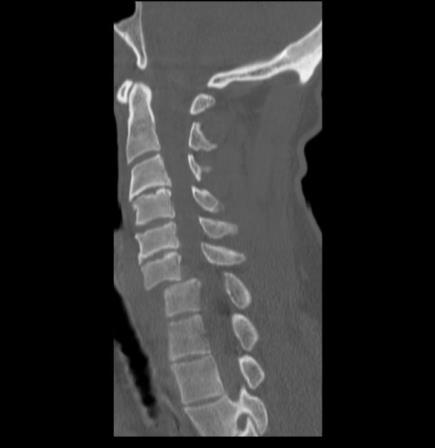
- Describe the main abnormality on the CT. (2 marks)
- 50% spondolysthesis of C6 on C7 – likely bilateral facet joint dislocation
- List three clinical findings you would expect from this injury. (3 marks)
- Loss of C6-C7 reflexes – triceps, extensor digitorum
- Neck pain
- Neurogenic shock
- Briefly describe the difference between neurogenic shock and spinal shock. (2 marks)
- Neurogenic shock – loss of SNS tone below level, so warm peripheries, hypotensive
- Spinal shock – concussion of spinal cord, flaccid paralysis, hypotension
- You note that a trauma call was not initiated by SAAS prior to arrival, and decide to activate one in ED. Regarding trauma calls:
- Give five indications for a trauma call based on history from the scene of the accident.
- Fatality on scene in same vehicle
- High speed collision
- Ejection from vehicle
- Serious or suspected serious penetrating injury
- Abnormal obs/intubation/rollover/fall >5m etc etc
- State an advantage and disadvantage of initiating a trauma call.
- Advantage: early assembly of team, minimises time to definitive treatment
- Disadvantage: potential for multiple people/overcrowding in resusc room/cost if not appropr
- Give five indications for a trauma call based on history from the scene of the accident.
- What is the role of high-dose steroids in this patient? (2 marks)
- Controversial – some recommend to reduce cord swelling, but not enough evidence to suggest as standard
SAQ 5
A 58 year-old male presents complaining of neck pain and being unable to lift his arms after a white water rafting incident. At triage, he is placed on a bed and a collar applied. He is haemodynamically stable, GCS 15, and has bilateral arm weakness.
- State the criteria you will use to determine whether this patient requires imaging of his cervical spine, and the name of the guideline where appropriate.
- NEXUS rules – midline tender/focal neuro/distraction/GCS/intox
- A CT of his C spine is ordered and the following result obtained (image below). State the abnormality on the scan and the likely cause of his symptoms.
- Extension teardrop fracture with likely central cord syndrome secondary to hyperextension.
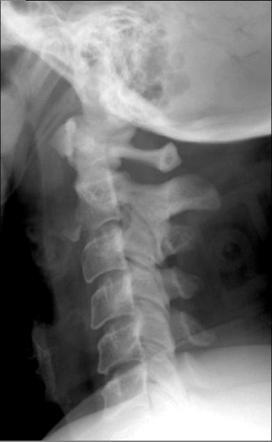
- The neurosurgery registrar is contacted and asks you to order extension/flexion films before he will review the patient. What is your response to this request?
- Say no – extension teardrop fractures are stable in flexion but potentially unstable in extension. Extension views of the patient may result in increased injury.
SAQ 6
- Regarding the Ellis classification of dental fractures, draw a line on each of the following teeth to indicate the location of the fracture for each Ellis type.
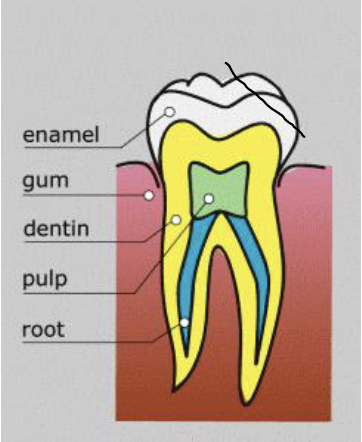
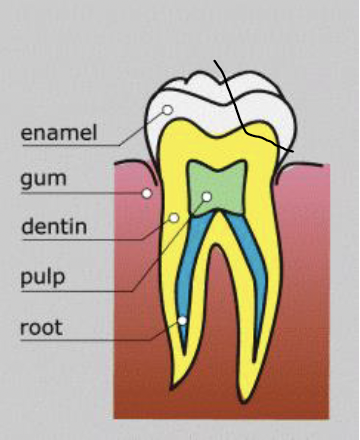
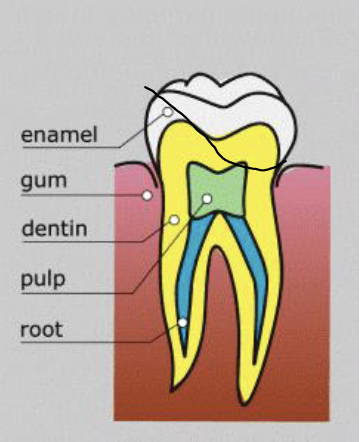
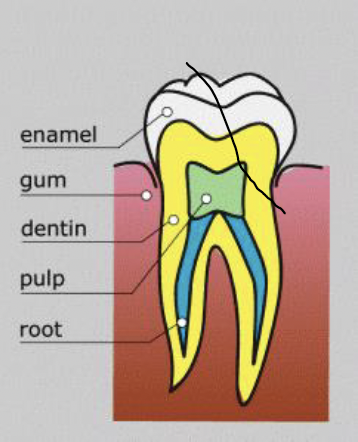
- Regarding the Le Fort classification of facial fractures, draw a line/lines on the following skull diagrams to indicate where the fracture(s) is/are.
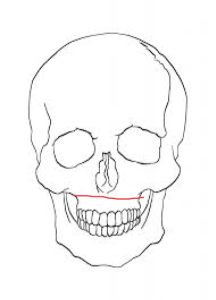
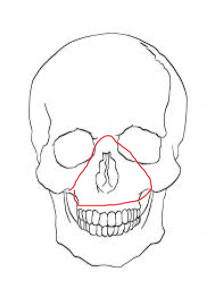
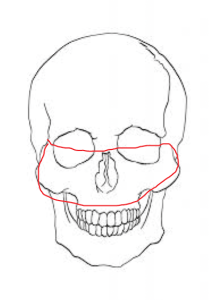
SAQ 7
A 78 year-old man is brought in by Medstar after being retrieved from Norton Summit, where he had fallen down a 10 metre cliff whilst hiking. He suffered no LOC at the scene, but required a fluid bolus en route for persistent hypotension. His GCS post-resuscitation with fluid is 10 (EVM 3-3-4) and he is agitated and confused. On arrival, his BP is 90/60, HR 110, T 36°, Sats 94% 2L O2. FAST scan shows no other injury. His wife has arrived and asks about his prognosis.
- List four factors which indicate a poor prognosis in any patient with a head injury. (4 marks)
- age (>40 years, worse with increasing age)
- low initial GCS post-resuscitation
- hypotension
- hypoxia
- pupil size and reaction to light (i.e fixed and dilated is bad!)
- raised ICP
- nature & extent of the intracranial injuries (worst to least, subdural -> extradural -> SAH)
- co-morbidities
- Define your endpoints for this patient in the following parameters. (6 marks)
| Temperature | 36-37°C, avoid hyperthermia |
| Oxygen saturation | Sats >94%, avoid hyperoxia (free radicals) |
| CO2 level | ETCO2 of 35 (low end normal) |
| BGL | BGL 6-10. Avoid extremes of BGL |
| Posture/positioning | 30° head up. |
| BP or MAP | MAP>90mmHg. |
- Define the difference between primary and secondary head injury, and state the neurochemical responsible for secondary injury. (3 marks)
- Primary injury – the initial trauma, cannot be avoided except by education/public health initiatives
- Secondary injury – due to the body’s response to the insult, involving glutamate release in response to factors such as hypoxia/hypotension/ischaemia etc that cause further damage to cells
- Will you administer prophylactic anticonvulsants to this patient? Justify your answer. (2 marks)
- I wouldn’t. Patient is already hypotensive (phenytoin may drop this further), and there is no indication if he has not seized.
- Anti-epileptic drugs (AEDs) prevent early seizures (NNT = 10, Cochrane Review) but have no impact on outcome or mortality.
- AEDs in the acute phase of TBI (first 7 days) do not reduce the incidence of PTS in the long term and are not recommended for this purpose.
- AEDs can have significant side-effects.

